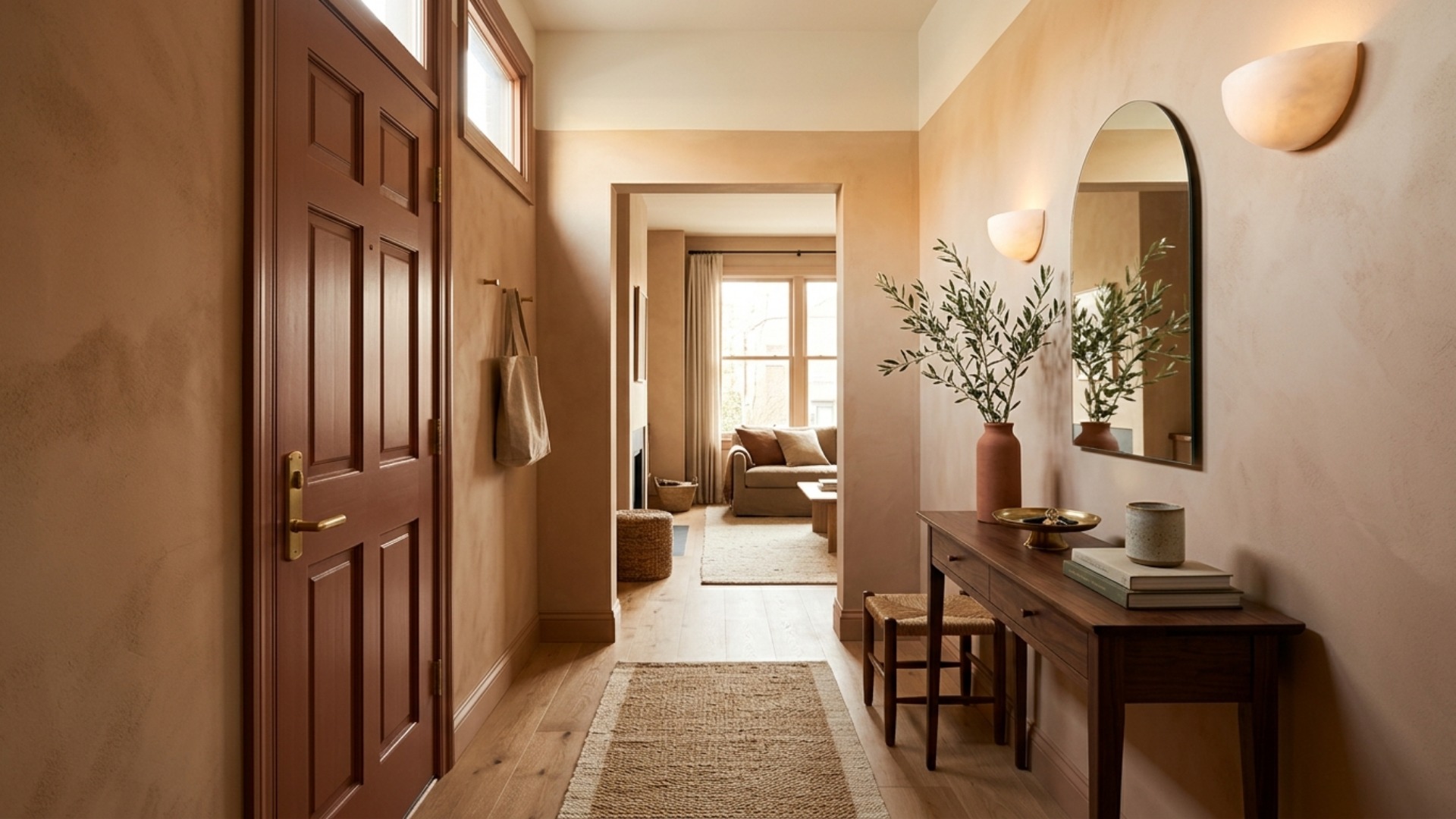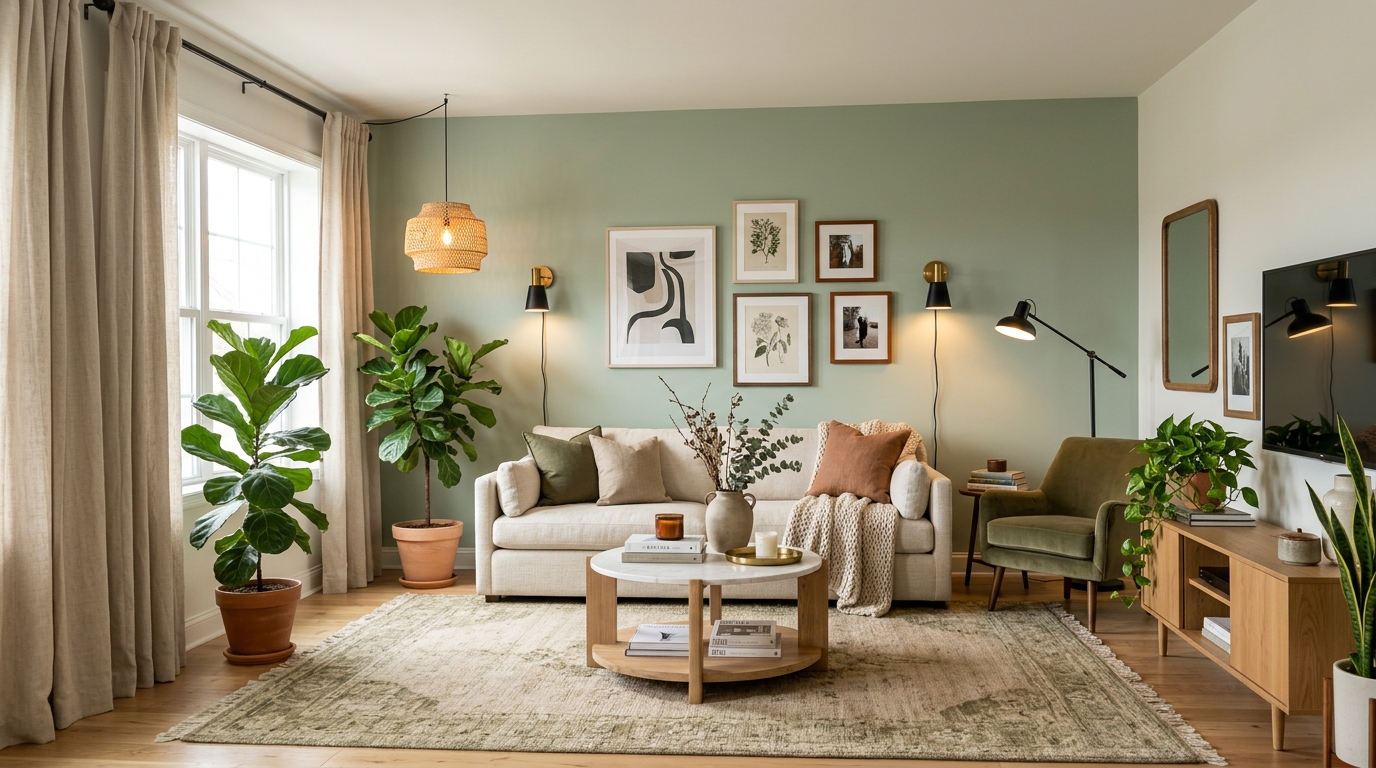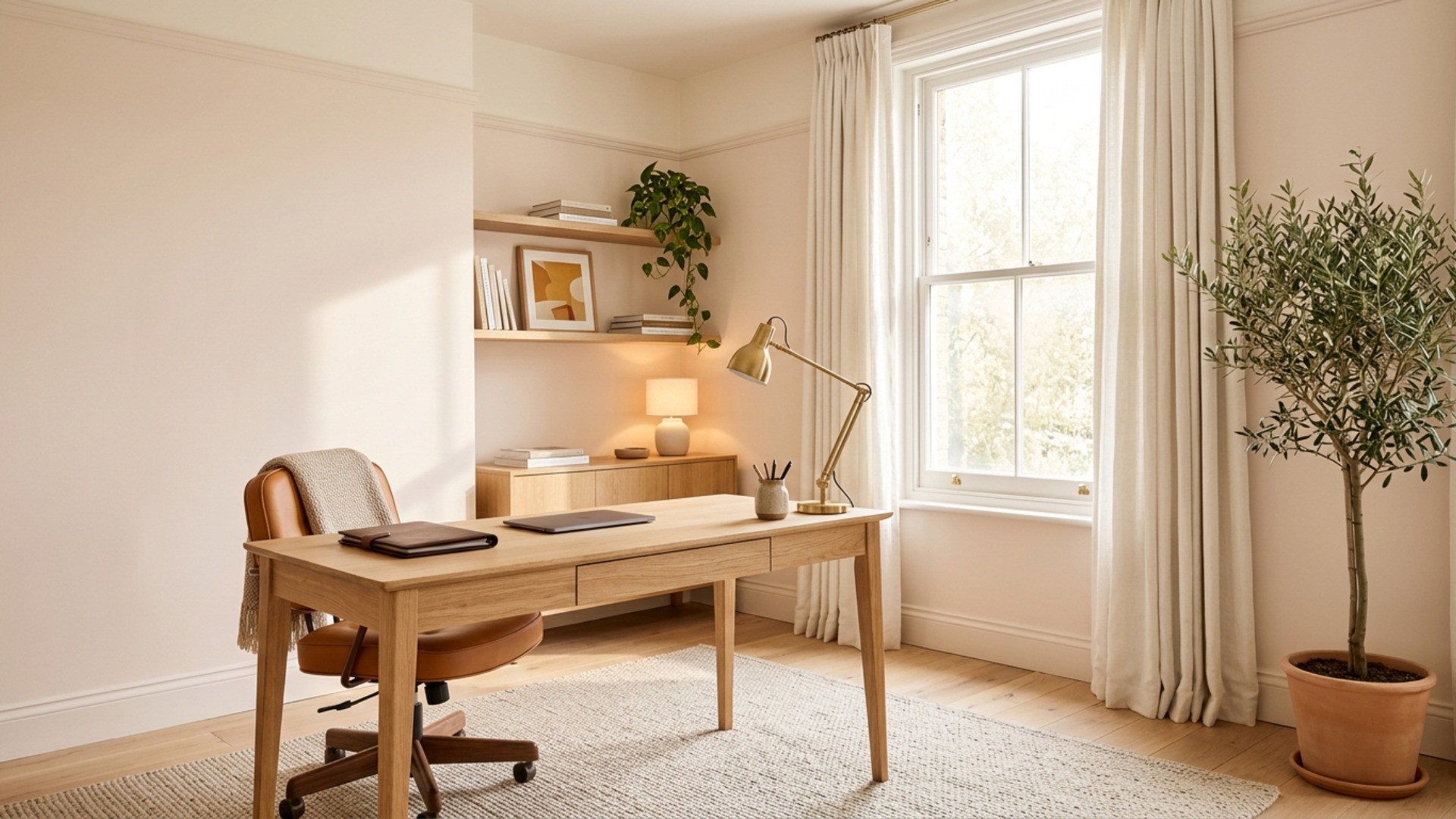
The dining table was supposed to be temporary. So was the chair from the kitchen, the extension cord snaking under the rug, and the stack of paperwork that now has its own postcode. Then temporary became a Tuesday in year four.
Working from home is no longer a novelty arrangement. The Bureau of Labor Statistics reports that 22.6 percent of American employees teleworked at least part of the time as of March 2026, and among people whose jobs can be done remotely, roughly three quarters do at least some of it from the sofa, the spare room, or the landing. That is a lot of hours in a room nobody actually designed. So let us design it. Not with a mood board and a wish, but with the eight decisions that separate a real office from a laptop with ambitions.
1. Desk Placement: The Window Question
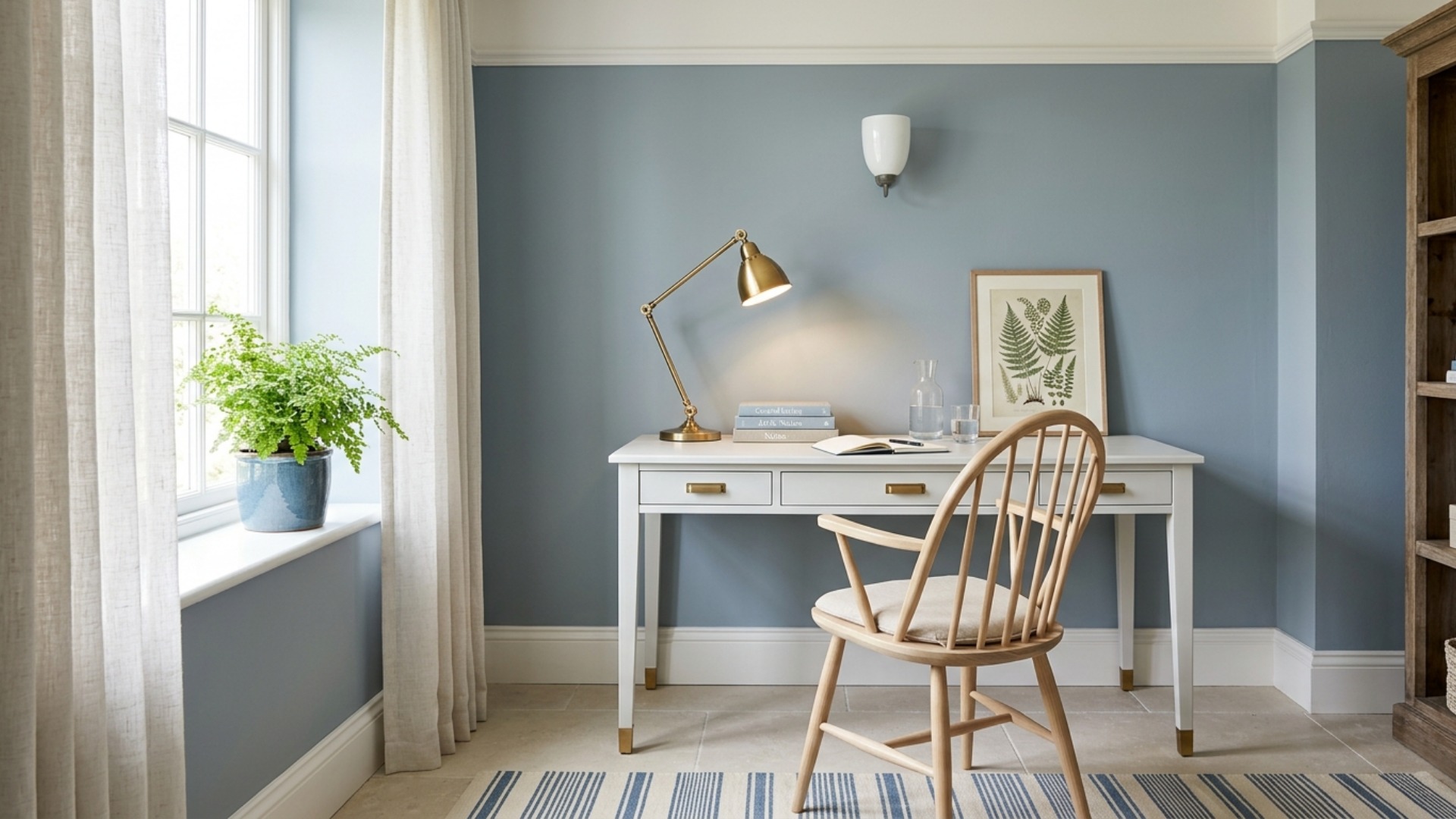
Everyone wants the desk facing the window. It is the most romantic possible choice and, for anyone who spends the day on a screen, one of the worst. Sit facing glass and you are staring into a light source all day, which means squinting, headaches, and a monitor washed out by 3pm glare. Put the window at your back and you get the opposite problem: your screen becomes a mirror and your video calls turn you into a witness in protection.
The answer is perpendicular. Set the desk so the window falls to your left or right, ideally within a few feet, and you get soft daylight across the work surface without a single reflection on the screen. If the room only allows a window-facing desk, add a sheer panel to diffuse the light and treat it as the fix, not the failure. Then the second rule: never float a desk in the middle of a room unless the back of it is beautiful. Most desks are not beautiful from behind.
2. The Two Measurements That Decide Whether Your Back Survives
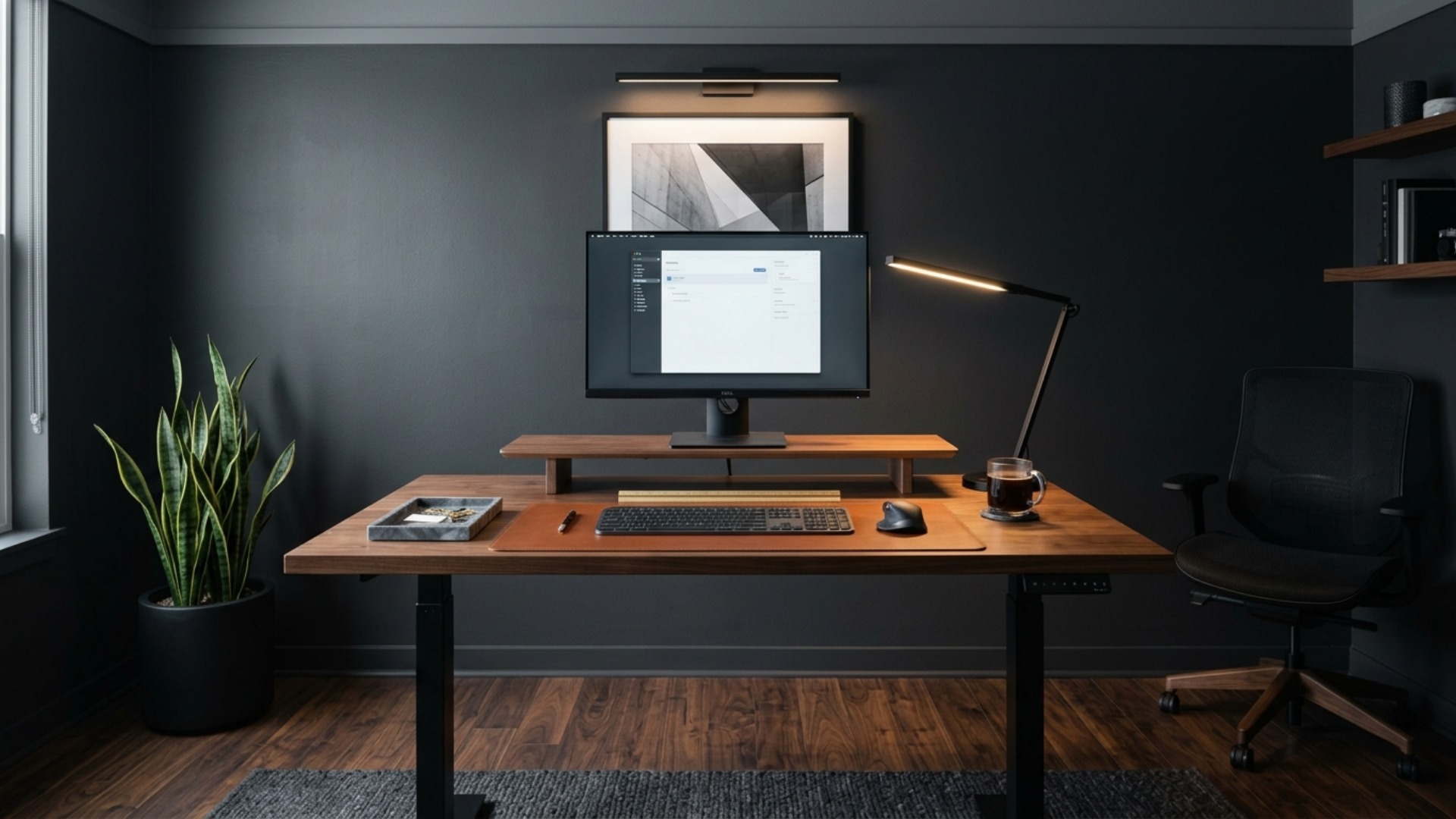
Comfort in a home office is not a vibe. It is two numbers, and almost everyone gets both of them wrong.
Desk height comes first. Your elbows should sit at roughly ninety degrees when your arms hang naturally and your forearms rest on the surface, which for most adults lands between 27 and 30 inches from the floor. Dining tables run around 30 inches and console tables can be higher, which is exactly why the temporary setup starts to ache in week two. Screen height comes second. The monitor wants to be about 20 to 28 inches from your eyes, with the top of the screen at or just below eye level. A laptop alone fails this by design, because the keyboard and the screen are welded together at a height that suits neither. A stand and a separate keyboard cost less than a good lamp and fix more.
Ergonomists are increasingly pointing to a 30:15 rhythm for 2026, thirty minutes seated to fifteen standing. You do not need a motorized desk to honor it. You need a reason to stand up, and a room worth standing up in.
3. Light It Like a Room, Not a Rehearsal Space
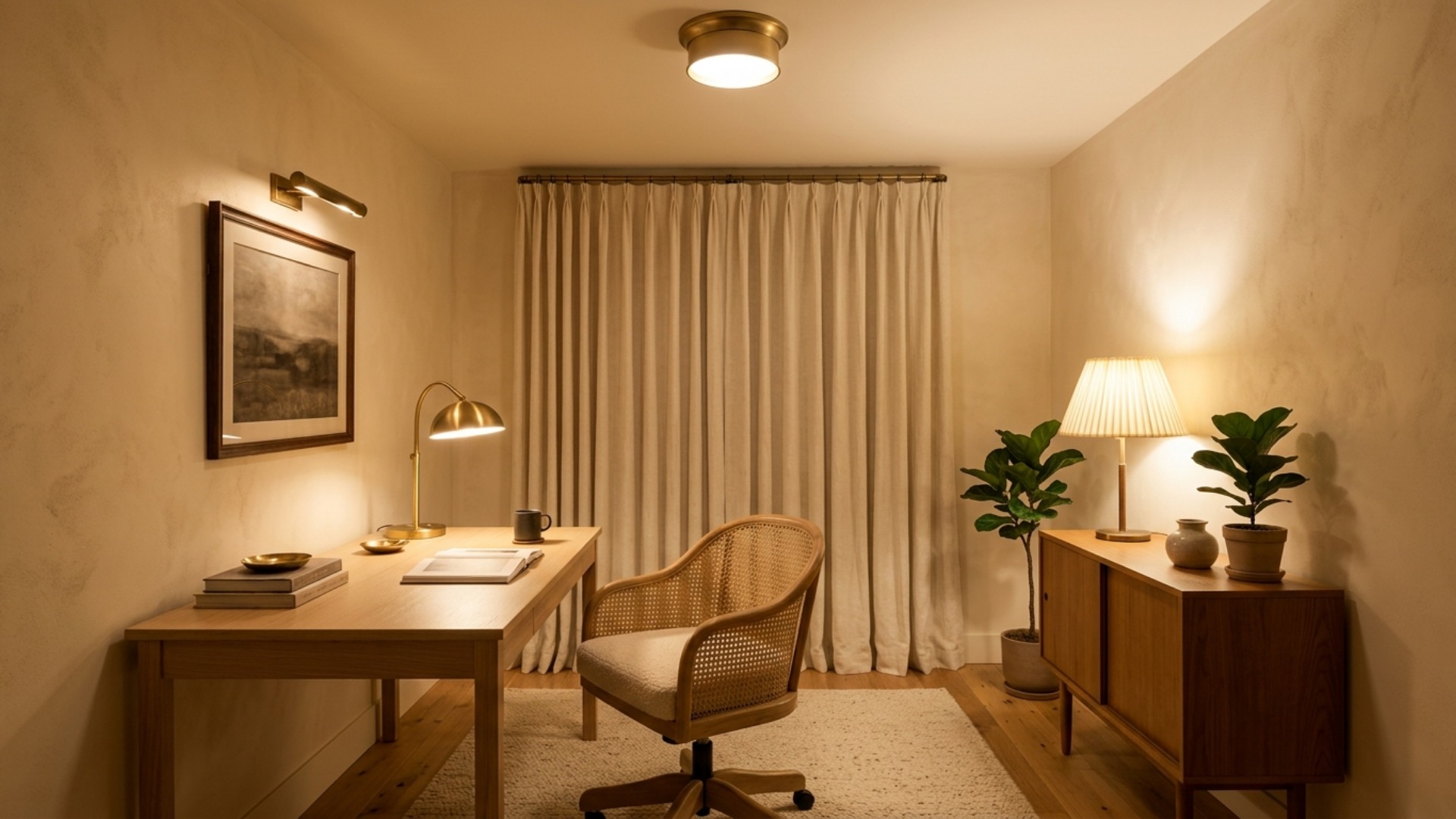
One ceiling fixture and a cold-white bulb is how you get a room that feels like a dentist's waiting area at 4pm in November. A working office wants three layers, same as any other room that gets used after dark.
Ambient light does the general lift, and it should be warm. Aim for 2700K to 3000K bulbs, which read as golden rather than clinical. Task light does the actual work: one adjustable desk lamp, positioned on the opposite side from your writing hand so it does not cast a shadow across the page. Accent light does the mood, and it is the layer people skip. A small picture light over the shelves, or a table lamp on a low cabinet, is what makes the room feel like part of the house rather than an outpost of the office. Put the whole lot on dimmers. Houzz reported searches for low-voltage lighting up 162 percent this year, which tells you the appetite for controllable, layered light is not niche anymore.
4. Your Video Call Background Is Part of Your Wardrobe Now
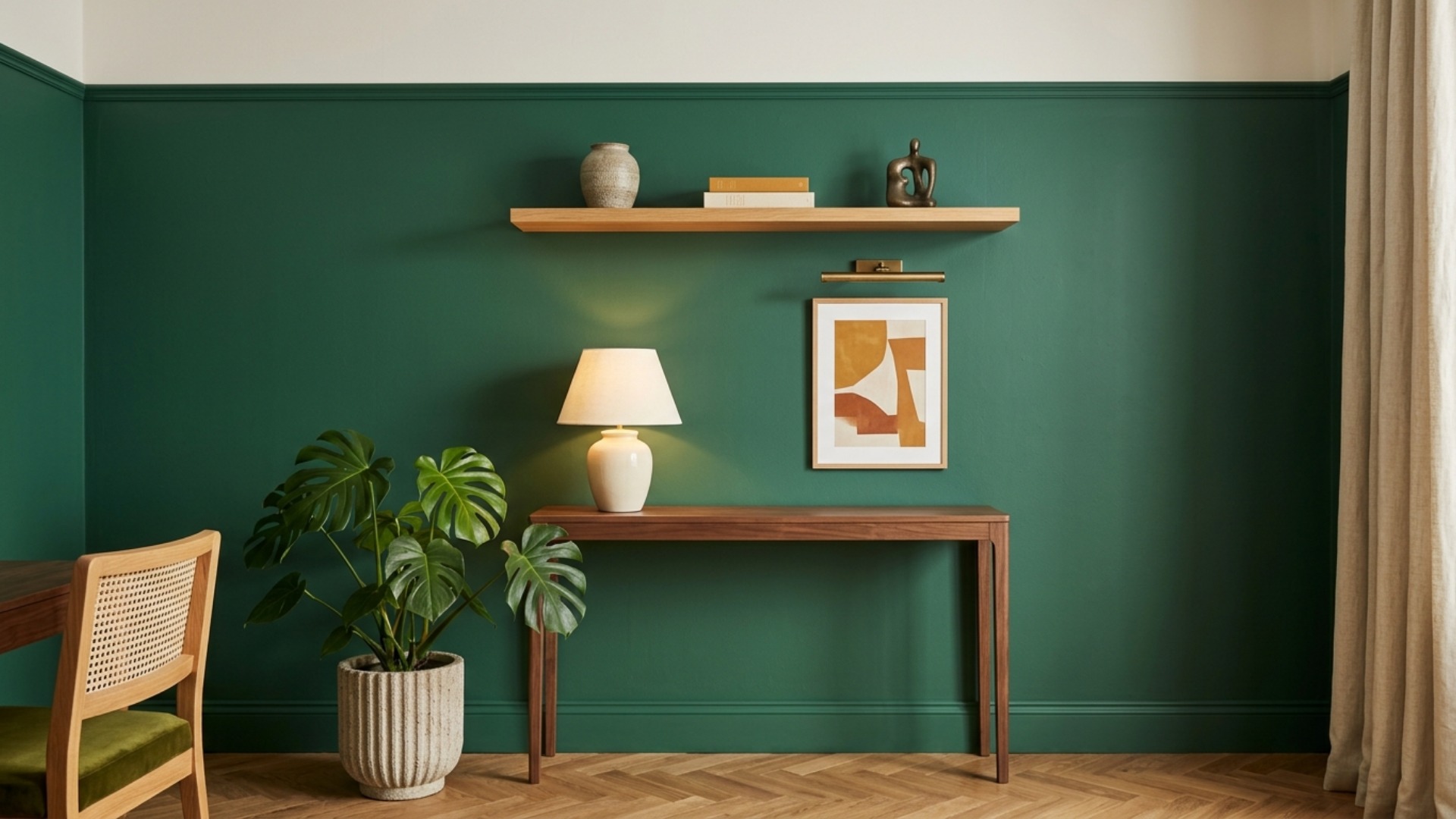
Somewhere between two and six hours of your week is spent as a small rectangle in other people's afternoons. That rectangle is a composition whether you treat it as one or not.
Style the wall behind you, not the whole room. The frame is narrow, so you only need about six feet of considered background: a piece of art hung slightly off-center, one shelf with two or three objects rather than eleven, a plant with real structure, and a lamp for depth. Avoid a blank white wall, which flattens you and makes the whole thing look like a hostage video, and avoid a bookshelf crammed to the ceiling, which reads as busy on camera even when it looks fine in person. Depth is the trick. Something four feet behind you and something twelve feet behind you gives the image dimension. And keep the laundry out of the shot, obviously, though it does say something about all of us that we had to mention it.
5. Storage That Refuses to Look Like a Filing Cabinet
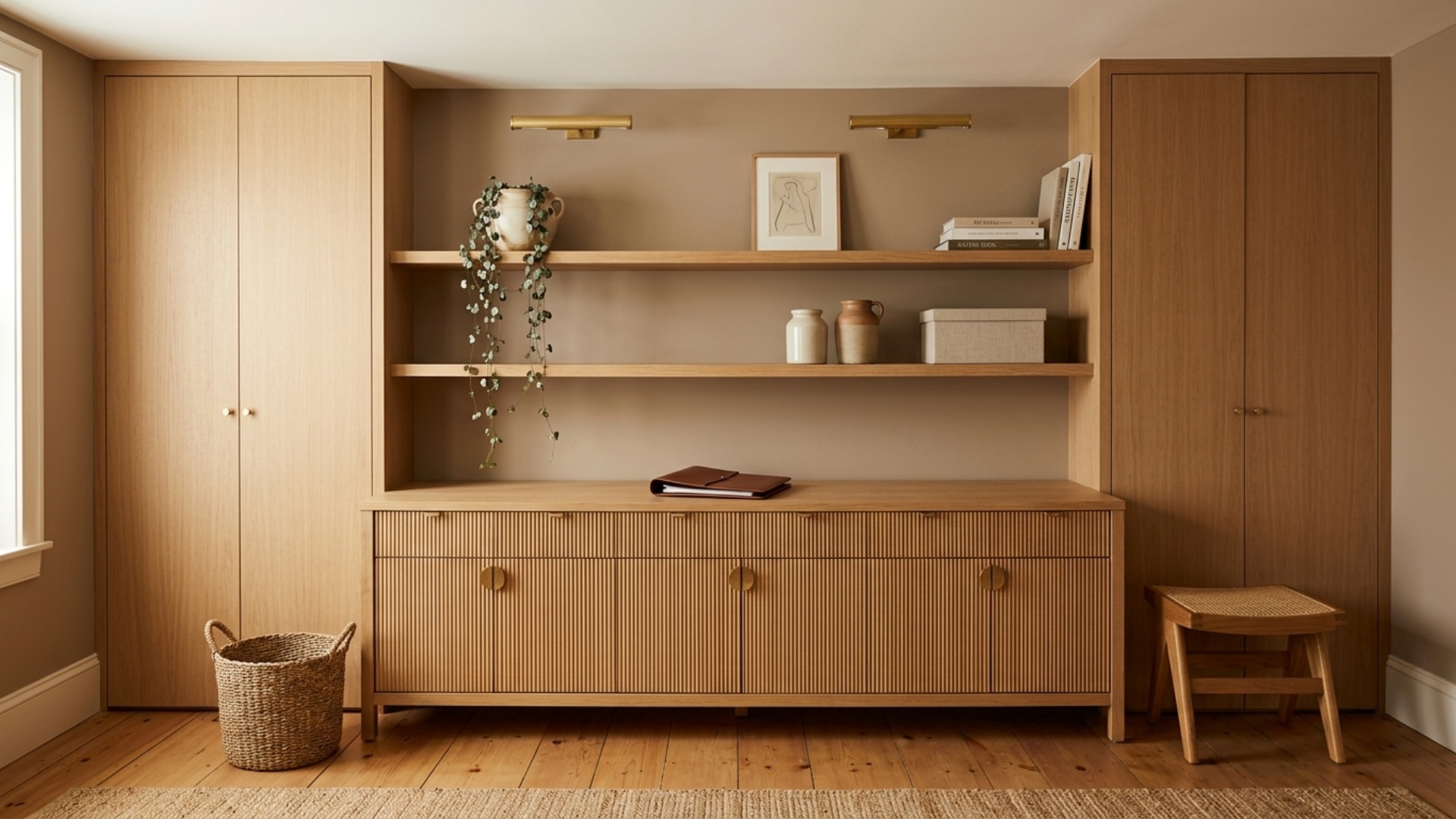
The instinct is to buy office furniture. Resist it. Grey pedestal drawers and a four-drawer steel filer will make your spare bedroom look like a repossessed insurance branch, and you will start closing the door on it.
Use domestic furniture instead. A low sideboard holds more than a filing cabinet, hides everything behind doors, and gives you a surface for a lamp. A vintage chest of drawers takes stationery and cables beautifully. A wall of closed cabinetry with two open shelves above it gives you the storage without the visual noise, since the closed part takes the ugly and the open part takes the objects you actually like. The working rule is a ratio: roughly eighty percent of your storage closed, twenty percent open. Then the surface rule, which is stricter. Your desk holds the screen, the light, one vessel for pens, and one beautiful object. Everything else lives somewhere with a door.
6. Acoustics: The Problem Nobody Designs Until It Is Already Ruining Calls
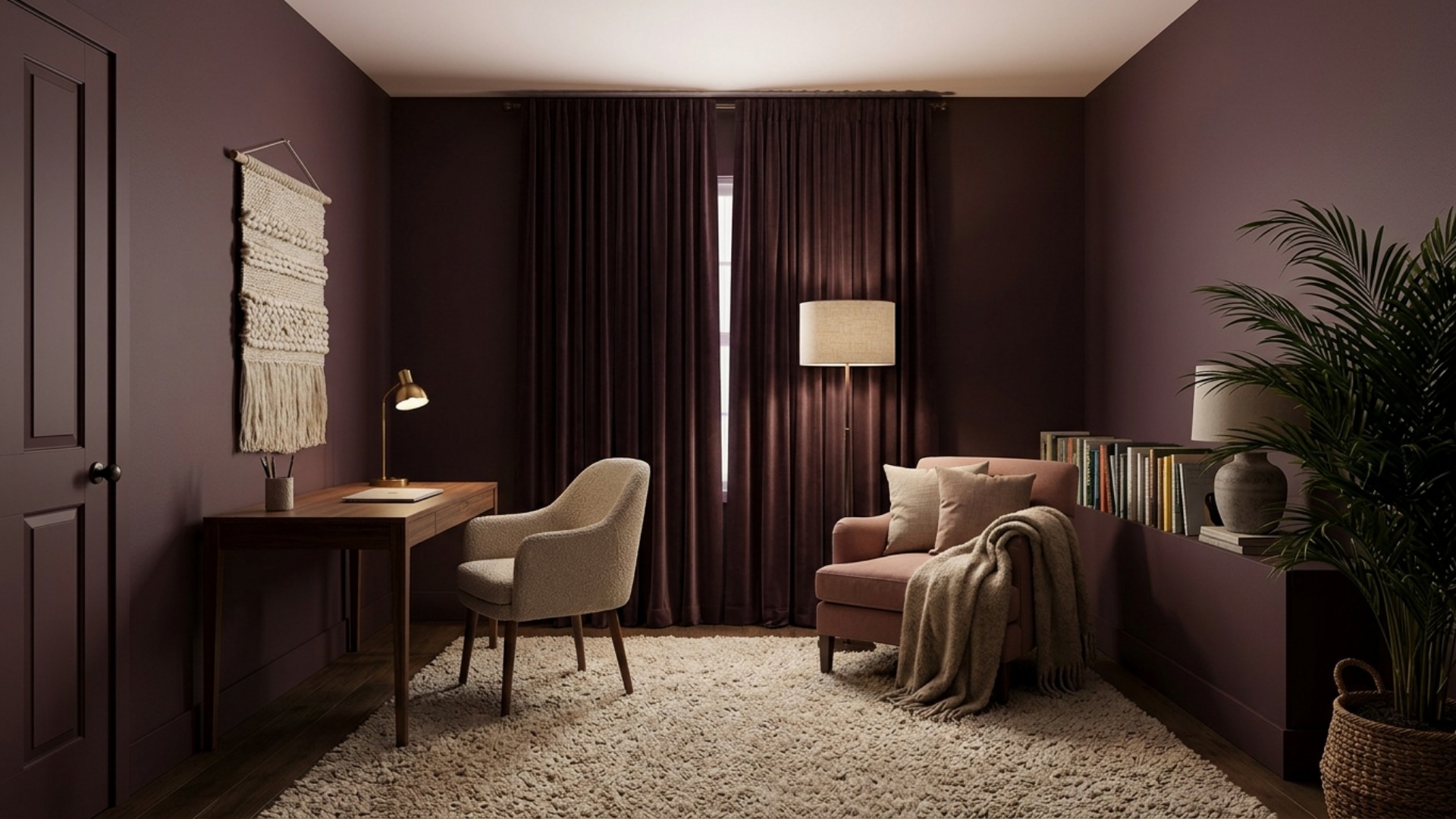
A spare room with a hard floor, a bare window, and one desk is an echo chamber, and your microphone will find every inch of it. This is the most common reason a home office feels subtly stressful without anyone being able to name why.
Soft surfaces are the whole solution and none of them look technical. A rug with a decent pile absorbs the floor bounce. Full-length curtains, even in a room where you never draw them, kill the reflection off the glass. An upholstered chair, a wall hanging, a run of books on open shelving, and a couple of cushions on a reading chair all do quiet acoustic work while pretending to be decor. If you share the house, the two cheapest structural fixes are a solid-core door instead of a hollow one, and a draft excluder along the bottom of it. Sound travels through gaps far more than through walls.
7. No Spare Room? Steal One.
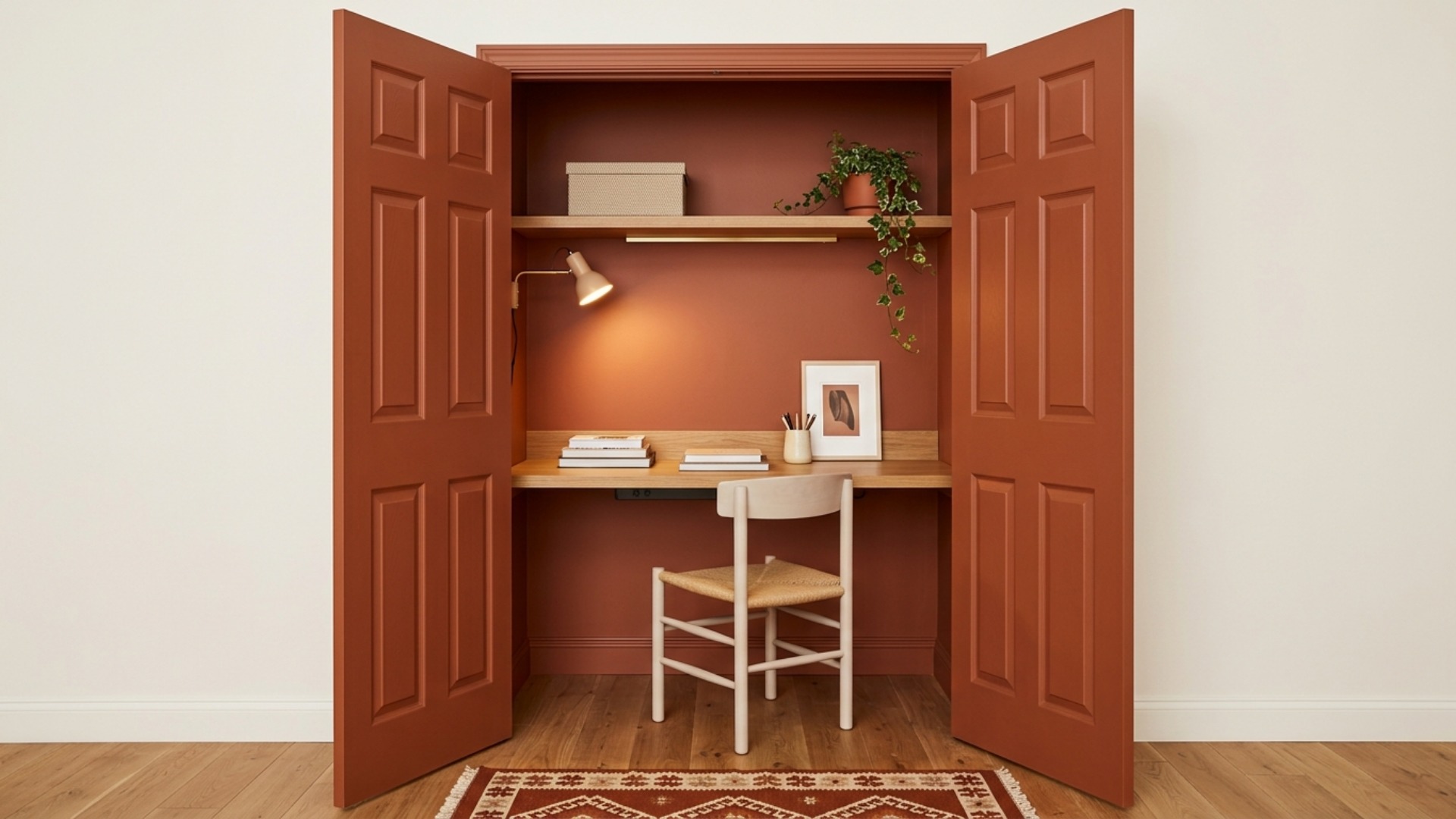
Most people do not have a spare room, and the good news is that a home office needs about fifteen square feet of genuine commitment rather than a whole floor plan.
The closet office, inevitably nicknamed the cloffice, is the neatest version. Remove the rail, fit a desk-depth shelf at 29 inches, add a shallow shelf above it for storage, run a power strip up the back wall, paint the interior a saturated color so it reads as deliberate, and hang doors you can close on the whole thing at 6pm. The landing is the second candidate, since a 30-inch console against the wall at the top of the stairs is a real desk if the chair tucks fully under it. The third is the corner. Take the least useful corner of the living room, define it with a rug and a pendant light, and the change in floor and ceiling does the work that walls would otherwise do. The principle is the same in all three: a home office is a zone with an edge, not necessarily a room with a door.
8. Cables, and the Closing Argument
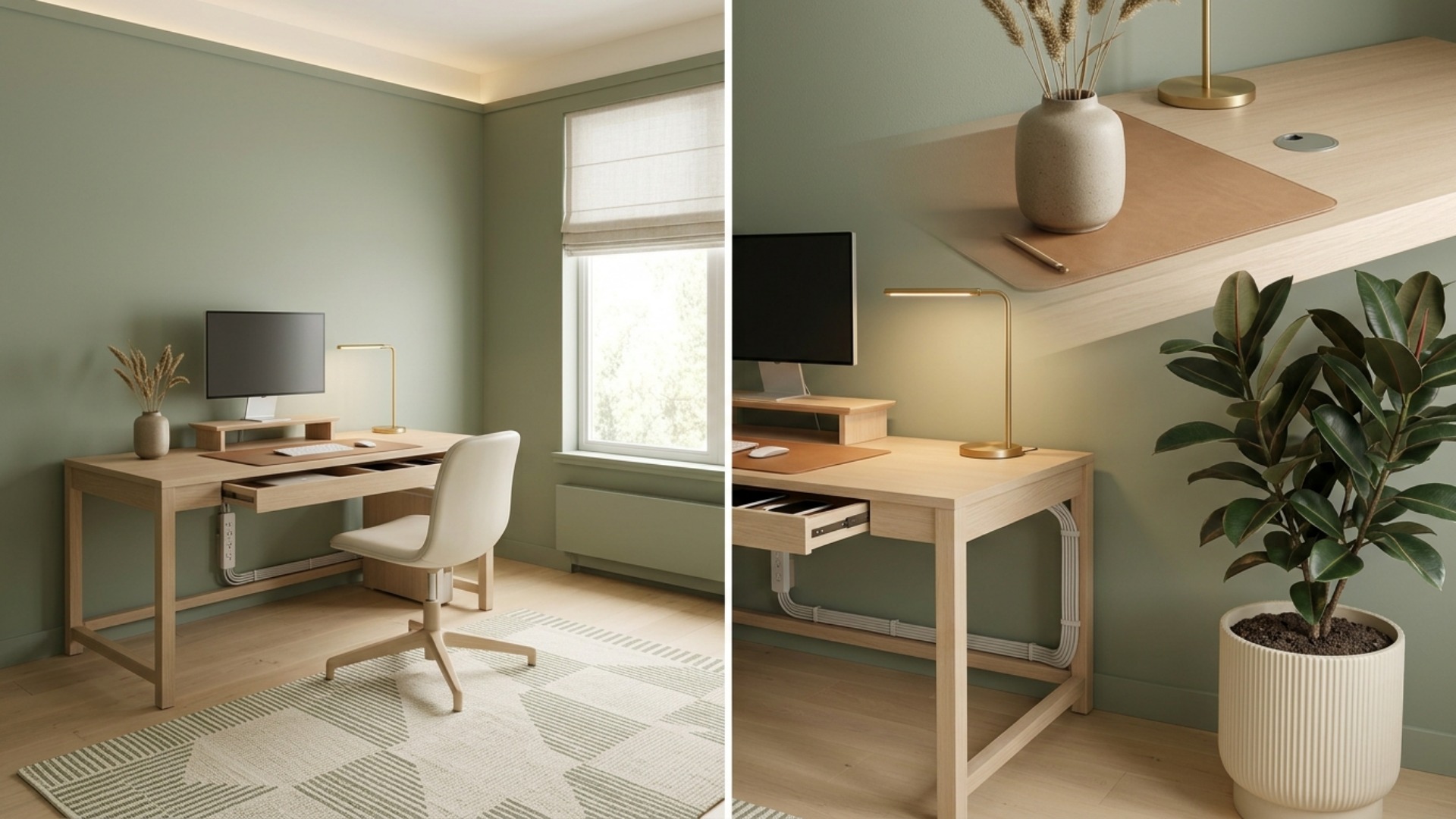
Nothing undoes a beautiful room faster than nine feet of black spaghetti under the desk. Cable discipline is twenty minutes of work and it is the difference between a designed room and a workstation. Mount a power strip to the underside of the desk so nothing runs to the floor. Use a single sleeve or a run of adhesive clips along the back edge. Label both ends of anything you will one day need to unplug in a hurry. Charge devices in a drawer with a grommet rather than on the surface.
Do all eight of these and the room stops being the place you work because you have to and becomes the place you work because it is the best room in the house. That is not a productivity trick. It is just what happens when a space is designed rather than defaulted into.
If you want to see it before you commit to it, that is precisely what Framehouse is for. Upload a photo of the corner, the closet, or the spare room, watch it reimagined with impeccable taste in minutes, then get a complete design playbook with everything you need to make it real.