Mid Century Modern Kitchen Ideas Under $5K
A mid century kitchen is one of the few looks you can reach for five thousand dollars without gutting anything, because the style depends on flat surfaces and warm wood rather than expensive stone. The trick is knowing which four things to spend on.
The real problem
Why this is harder than it looks
Five thousand dollars does not buy a new kitchen, and every page that suggests otherwise is quietly assuming you already have decent cabinet boxes and are only counting materials. That assumption is worth making explicit, because it is also the good news. Cabinet carcasses are the expensive part of a kitchen and the part nobody sees. If yours are solid and the layout works, the visible kitchen is almost entirely doors, counters, hardware, and light, and all four are within reach at this budget.
Mid century modern is unusually well suited to that constraint. It was a style built for mass production in a period when nobody was importing slabs of Calacatta. Flat slab doors, laminate counters, and modest hardware are not compromises here, they are the actual vocabulary. A honed marble waterfall island would look wrong in this kitchen even if you could afford one.
The specific starting point most people have is a kitchen from somewhere between 1995 and 2015: raised panel oak or white shaker doors, a granite or dark laminate counter, brushed nickel bar pulls, and a lot of upper cabinets. Nothing about it is broken, which is exactly why it is hard to justify replacing. The work here is subtractive as much as additive.
The failure pattern is spending the whole budget on one gesture, usually a countertop. New quartz swallows four thousand dollars, leaves the raised panel doors untouched, and the kitchen still reads as the kitchen you had. The doors and the upper cabinets are what date a room. Change those first and the counter you already own will look considerably better than it does now.
A clear path
How to plan it
-
01
Take down the upper cabinets on one wall
This costs nothing but a weekend and a bag of filler, and it does more for a mid century kitchen than any purchase. Removing uppers on the window wall or the sink wall opens the horizontal band the style is built around. Patch, sand, and paint the wall, then put back one open walnut shelf about 18 inches above the counter. Keep the uppers on the wall you actually need for storage. This is not an all or nothing move.
-
02
Replace the doors and drawer fronts, not the cabinets
Flat slab fronts in walnut veneer or paint-grade MDF fit standard Ikea and most stock carcasses, and a full kitchen of them runs roughly $1,200 to $2,200 from suppliers like Semihandmade or a local shop working from your measurements. This is the single biggest visual change available at this price. Order slab fronts with no bevel and no shadow line, since any profile at all pulls the kitchen back toward shaker.
-
03
Paint the lower run a saturated colour and leave the walls quiet
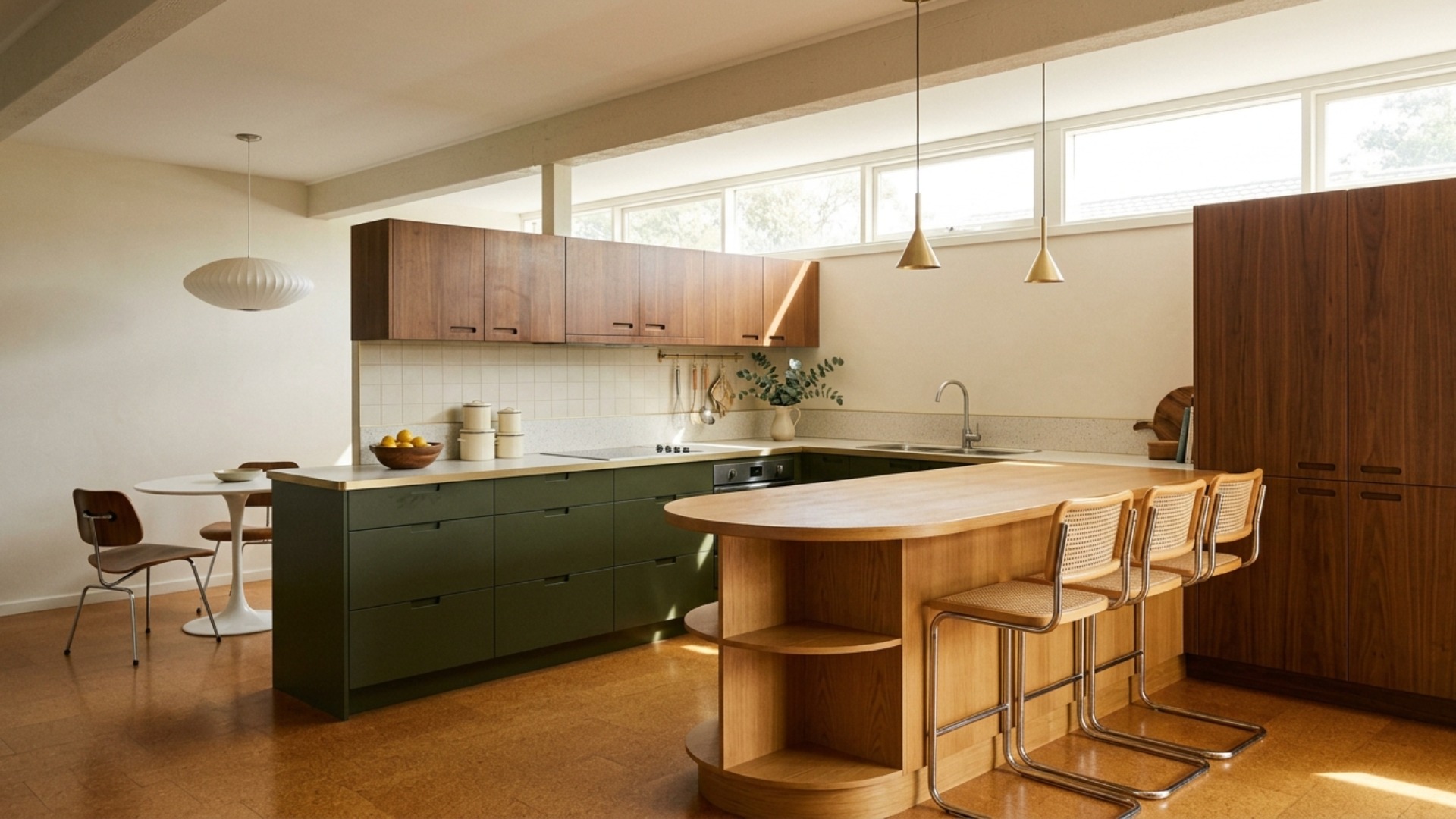
Mid century kitchens used real colour on the cabinetry rather than on the walls. A deep olive, a muted teal, or a soft mustard on the lower run against bone white walls costs about $90 in paint and instantly dates the kitchen to the right decade. Farrow and Ball Bancha and Benjamin Moore Dark Olive both work. Use a cabinet enamel rather than wall paint, and keep the walls a warm off-white so the colour stays the event.
-
04
Spend the rest on hardware, one light, and the stools
Slim brushed brass finger pulls or simple round wooden knobs run about $150 for a full kitchen and are the detail people notice at close range. A single good pendant over the table, a Nelson Saucer or a decent reproduction, is around $250 to $400 and does more than four recessed cans. Two or three Cesca style cane and chrome stools finish the peninsula for about $400. That leaves room in the budget for the counter if the existing one is genuinely bad.
-
05
Test the wood and the colour in Framehouse before you order fronts
Walnut against your floor and a saturated olive against your existing counter are the two decisions in this project that cannot be judged from samples, and door fronts are non-returnable once cut. Photograph the kitchen from the doorway, run the mid century modern direction, and look at the wood tone and the cabinet colour together in your own light before the order goes in.
Built for budget under 5k
Moves that pay off
Five thousand dollars in a kitchen goes furthest when it is spent on the parts you can see and skipped on the parts you cannot.
- Spend in this order: doors and fronts, then paint, then hardware and lighting, then the counter if anything is left.
- Keep the appliances. Even mismatched ones read as fine in this style, and replacing a working fridge will take a third of the budget for no visual gain.
- Do not move plumbing or gas. The moment a sink or a range shifts position, this stops being a five thousand dollar project.
- Refinish rather than replace where the material is real. Solid wood doors can be stripped and stained walnut for the cost of materials and two weekends.
- Laminate is correct here, not a compromise. A cream and grey speckle or a plain warm white laminate with a slim brass edge is period accurate and costs a fifth of quartz.
- Hold back $500 for the unexpected. Removing upper cabinets almost always reveals a patch of unpainted wall or an old tile edge that needs solving.
mid century modern cues
What to keep, what to skip
Mid century kitchens are defined by horizontal lines and warm wood, and they fall apart when the details drift toward a different decade.
- Palette: warm wood as the anchor, bone white or soft cream as the field, and one saturated cabinet colour such as olive, teal, or mustard.
- Materials: walnut and teak veneer, cork or vinyl flooring in warm tones, laminate counters, cane webbing, and brushed brass or chrome.
- Structural signature: the unbroken horizontal run. Long low cabinetry with as few visual breaks as possible, and open wall above wherever storage allows.
- Hardware: slim and recessed. Long finger pulls, small round knobs, or an integrated lip. Nothing bulky, nothing oil rubbed bronze.
- Lighting: one sculptural pendant doing the work, plus warm 2700K under-cabinet strips. Avoid a grid of recessed downlights, which flattens the room.
- Skip: raised panel doors, subway tile in a herringbone, farmhouse sinks, open shelving on every wall, and orange and brown used together.
Use it for
What people plan with Framehouse
- Test walnut fronts against your existing floor before ordering
- See a deep olive lower run with the counter you already have
- Check whether removing the upper cabinets leaves enough storage
- Compare brass finger pulls against chrome on the same doors
- Show a partner the kitchen before committing to slab fronts
Quick answers
Common questions
Make a plan you can act on
Skip the spiral of mood boards. Three minutes in the Aura Quiz turns your taste into a direction.
Take the Aura Quiz