Japandi Studio Apartment Ideas Under $5K
Japandi is the rare style that gets better as you buy less, which makes it unusually kind to a studio and a five thousand dollar budget. This page lays out where that money actually goes, and in what order to spend it.
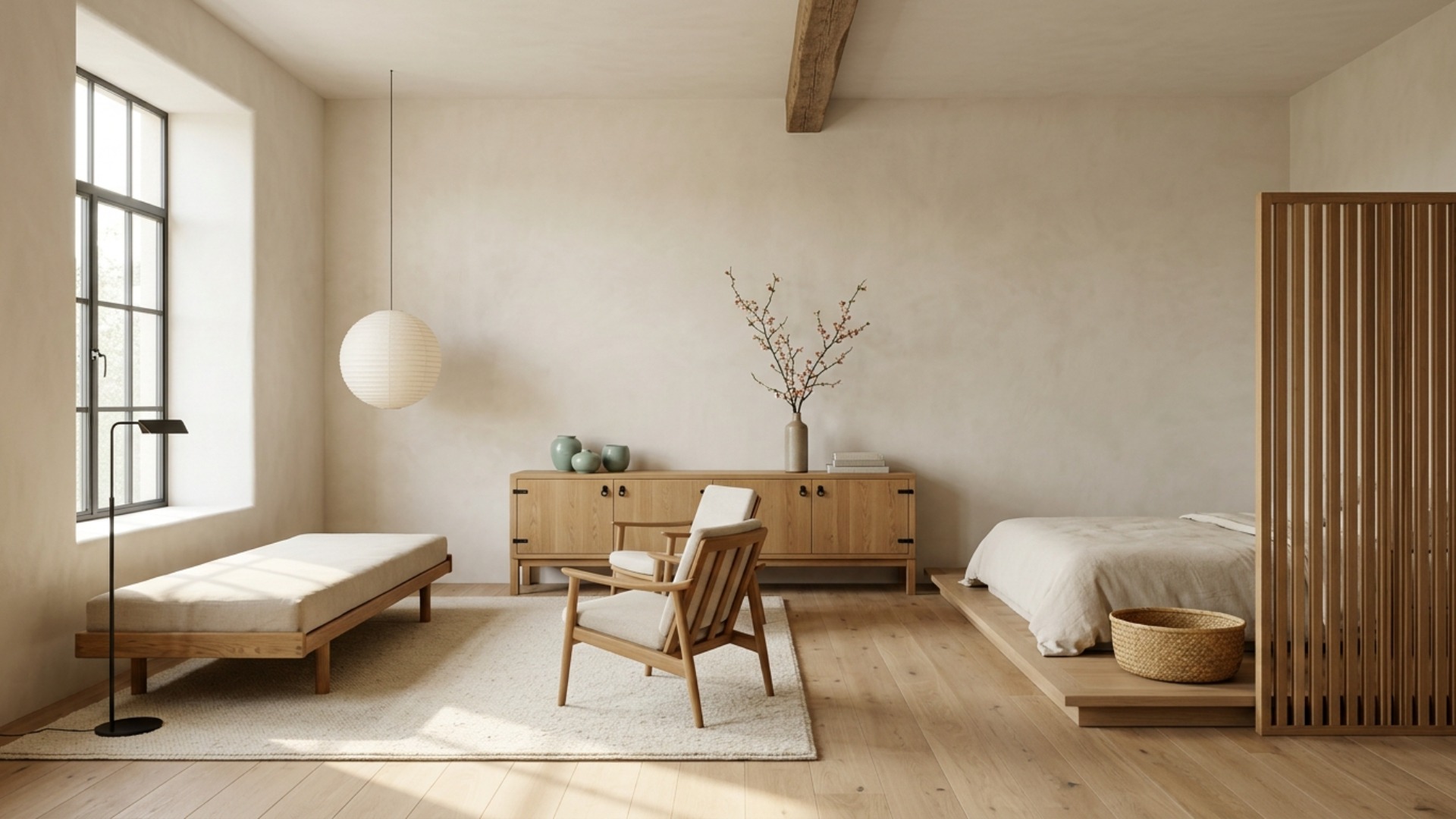
The real problem
Why this is harder than it looks
Most people meet japandi as a mood board of beige and then shop it that way: a low bed frame, a paper lantern, a linen throw, and a small forest of dried pampas grass. The room comes out quiet and oddly lifeless, like a showroom nobody has walked through yet. The pieces are all technically correct and the room still feels like a stage set.
Japandi is not a palette. It is two traditions that happen to agree on one thing, that an object should show how it was made. Japanese joinery and Scandinavian craft both leave the work visible: an exposed tenon, a hand-planed edge, a wool that has not been dyed into submission. The warmth comes from that evidence. It does not come from the color beige, which is why a room full of beige things can still feel cold.
In a studio that principle is doing double duty. You look at your bed, your desk, and your kitchen from one point on the sofa, so every piece is on display all the time. There is no hallway to hide the cheap thing in and no door to close on the mess. A studio punishes a room full of near-misses far more than a two bedroom does.
The failure pattern under a five thousand dollar budget is spreading it evenly. Nine hundred on a sofa, six hundred on a bed, four hundred on a rug, and onward until everything in the room is competently mediocre. Japandi does not survive that. It wants two or three genuinely well made pieces and a lot of restraint everywhere else, which is a much easier target to hit on this budget than most people expect.
A clear path
How to plan it
-
01
Paint the whole studio one warm off-white
Do this while the room is still empty, when the work is fast and nothing needs moving. Use one color on every wall, and carry it onto the trim if the trim is uninspired builder stock. Benjamin Moore White Dove and Farrow and Ball Pointing both read warm without turning yellow under LED. Two coats in a 500 square foot studio runs about $180. Skip accent walls entirely: a studio reads as one volume, and a break in the color chops it into pieces.
-
02
Spend the largest single share on the piece you touch every day
In a studio that is almost always the sofa or the bed, and it should take roughly $1,400 to $1,800 on its own. Look for a solid oak or ash frame with joinery you can see rather than a stapled plywood box hiding under a slipcover. Article's Nord and Burrow's oak-legged frames sit in this range. This one piece carries the craft argument for the entire room, so buying it last, after the budget has been nibbled down, is the most common way this goes wrong.
-
03
Give the room one real divider instead of five small ones
The bed needs to stop being the first thing you see, and the cheap fix is usually a curtain, which reads as a dorm. Set a single open oak shelving unit or a slatted screen perpendicular to the wall at the foot of the bed, around $300 to $600. Leave it open at the top so daylight still crosses the room. One tall object doing this job looks deliberate. Three low ones look like you ran out of ideas.
-
04
Buy texture rather than objects
The remaining $800 or so goes much further in materials than in decor. A washed linen duvet in oatmeal, a heavy wool or jute rug wide enough to sit under the seating, unlined linen curtains hung close to the ceiling and running to the floor. Those are the things that make a room feel lived in. Resist filling the shelves: japandi holds up because of the empty space between things, so every extra vase is money spent making the room worse.
-
05
Visualize the studio in Framehouse before you commit the budget
Five thousand dollars in a studio is one shot, and the two decisions hardest to judge in advance are the off-white and the wood tone. A paint chip lies about how a color behaves across a whole wall, and an oak swatch on a screen tells you nothing about how it will sit against your floor. Upload a photo of the room, run the japandi direction, and look at the divider placement and the palette together before anything is ordered.
Built for budget under 5k
Moves that pay off
Five thousand dollars is enough for a studio to look genuinely considered, but only if it is spent in sequence rather than all at once.
- Split the money in three parts: roughly 35 percent to the sofa or bed, 25 percent to storage and the divider, and the rest to soft materials and light.
- Do paint and curtains first. Both are cheap, both change the room more than any single object, and both are much harder once the studio is full.
- Defer the dining table. A studio can eat at a small round table or a counter for a year while you learn where you actually sit.
- Do not buy art in the first pass. Blank walls read as intentional in japandi, and art bought to fill a gap is the purchase people regret first.
- Buy the case goods secondhand. Solid wood sideboards, shelving, and dressers are the best value on Facebook Marketplace and the least risky category to buy used.
- Hold back about $400 for three months. The gap you actually have will not be the one you predicted from an empty room.
japandi cues
What to keep, what to skip
Japandi is easy to approximate and hard to get right, and the difference is almost always in the materials rather than the layout.
- Palette: warm off-white walls, light oak or ash, matte black used sparingly on hardware and frames, and one muted natural accent such as celadon or clay.
- Materials: solid wood with visible grain, paper, unbleached linen, wool, ceramic with a hand-thrown edge. Nothing high gloss, nothing imitating another material.
- Structural signature: low horizontal lines. Beds sit close to the floor, sideboards run long and low, and the eye travels sideways rather than up.
- Light: warm bulbs at 2700K in several small pools rather than one ceiling fixture. A paper lantern and a floor lamp beat a single overhead every time.
- Craft over quantity: one well-made oak stool earns more than four decorative objects, and the empty surface around it is doing real work.
- Skip: pampas grass, script signage, three competing metals, and anything sold as a japandi bundle. Bundles are how a style becomes a costume.
Use it for
What people plan with Framehouse
- Test a warm off-white against your studio's actual daylight before buying two gallons
- See whether the bed reads as separate once a divider goes in at the foot
- Compare a light oak sofa frame against the floor you already have
- Show a partner the whole studio as one room before the budget is committed
- Check that a low bed frame still leaves the window looking correctly proportioned
Quick answers
Common questions
Make a plan you can act on
Skip the spiral of mood boards. Three minutes in the Aura Quiz turns your taste into a direction.
Take the Aura Quiz