Coastal Bedroom Ideas for an Empty Room
An empty bedroom gives you the one thing a furnished one never does: control over the order you buy in. Coastal rewards that, because the look lives in surfaces and light rather than in any single piece of furniture.
The real problem
Why this is harder than it looks
An empty bedroom feels like freedom for about a week, and then it starts to feel like pressure. With nothing in the room there is nothing to react against, so most people default to shopping. They open a coastal moodboard, see rattan, linen, and a pale blue cushion, and start buying the decorative layer first. Six weeks later the room has a jute rug, three woven baskets, and still no working light beside the bed.
Coastal is not a furniture style. It is a surface and light style, which is why it works so well in a bedroom and so badly as a shopping list. A bedroom is mostly wall, ceiling, and floor, with one large soft object in the middle. Get the walls, the floor, and the light right and almost any calm bed frame will read coastal. Get them wrong and no amount of rattan will rescue it.
The starting point is usually identical from house to house. Builder white walls with a faint blue undertone, a bare bulb or a flush ceiling fitting, laminate or carpet nobody chose, and one uncovered window. Nothing is broken, which is exactly why the room gets furnished instead of finished.
The failure pattern in an empty room is buying the biggest thing first. A bed ordered from a photograph, before the wall colour is settled and before you have stood in the room at nine at night, sets the scale for everything that follows and cannot be undone cheaply. The right order is close to the reverse of the exciting one: shell, then bed, then light, then the soft layer everyone wants to buy on day one.
A clear path
How to plan it
-
01
Paint the shell while the room is still empty
You will never have a better opportunity than a room with nothing in it. Take the walls, ceiling, and woodwork in one warm chalky off white with no blue in it: Farrow and Ball Slipper Satin, Little Greene Slaked Lime, and Dulux Natural Hessian all sit in the right range. Two coats across an empty room is a Saturday and under 150 dollars. Doing the same job later costs you a weekend of moving furniture.
-
02
Decide the bed size on the floor, not on a website
Tape the footprint of a double and a king onto the floor with painter's tape and live with it for two days. In most bedrooms under 12 square metres a double leaves a real walkway and a king does not, and the walkway matters more at six in the morning than the extra 15cm of mattress does at midnight. Choose a low frame in bleached ash or soaped oak, since height is what makes a bed feel bulky, not width.
-
03
Fix the floor before you spend anything on a rug
A pale floor does more coastal work than any accessory. If there are boards under the carpet, sanding and finishing them in a matt hardwax oil runs roughly 40 to 60 dollars a square metre and changes the room permanently. If you are stuck with what is there, a large flat weave wool or jute rug that runs under the bed and out at least 50cm on each side is the cheaper fix, and buying it after the bed arrives is the only way to size it correctly.
-
04
Put in three light sources and retire the one on the ceiling
A single overhead fitting flattens a pale room and makes limewash read grey. Aim for a soft pendant or a simple linen shade on a dimmer, a wall mounted swing arm lamp on each side of the bed at about 1.2m from the floor, and one low lamp on a chest across the room. Keep every bulb at 2700K. Mixing colour temperatures is the most common reason a coastal bedroom looks cold in photographs.
-
05
Visualize the finished room in Framehouse before the big order lands
Wall colour and bed scale are the two decisions in an empty room that are expensive to reverse, and both are close to impossible to judge from a paint chip and a product photo. Photograph the empty room from the doorway and use Framehouse to try the off white against your own light, the low bed against a taller one, and the rug at two sizes. It takes a few minutes, and it happens before the delivery slot rather than after it.
Built for empty room design
Moves that pay off
An empty room is a sequencing problem more than a taste problem. The order you buy in decides how much of the result you actually get to keep.
- Do the painting in the first fortnight, before anything is in the way.
- Split the budget roughly 50 percent bed and mattress, 20 percent lighting, 20 percent floor, 10 percent everything else.
- Buy the mattress at full quality and the frame at whatever you can afford, since frames get replaced and mattresses get lived with.
- Defer the rug, the art, and the window treatment until the bed is in and you have seen the room after dark.
- Resist filling the corners. An empty corner in a pale room reads as calm, and a corner filled to look finished reads as storage.
- Do not buy a matching bedroom set. It is the fastest way to make a brand new room look like a showroom floor.
coastal cues
What to keep, what to skip
Coastal in a bedroom is a narrow tonal range plus a lot of texture. Nothing here needs to reference the sea.
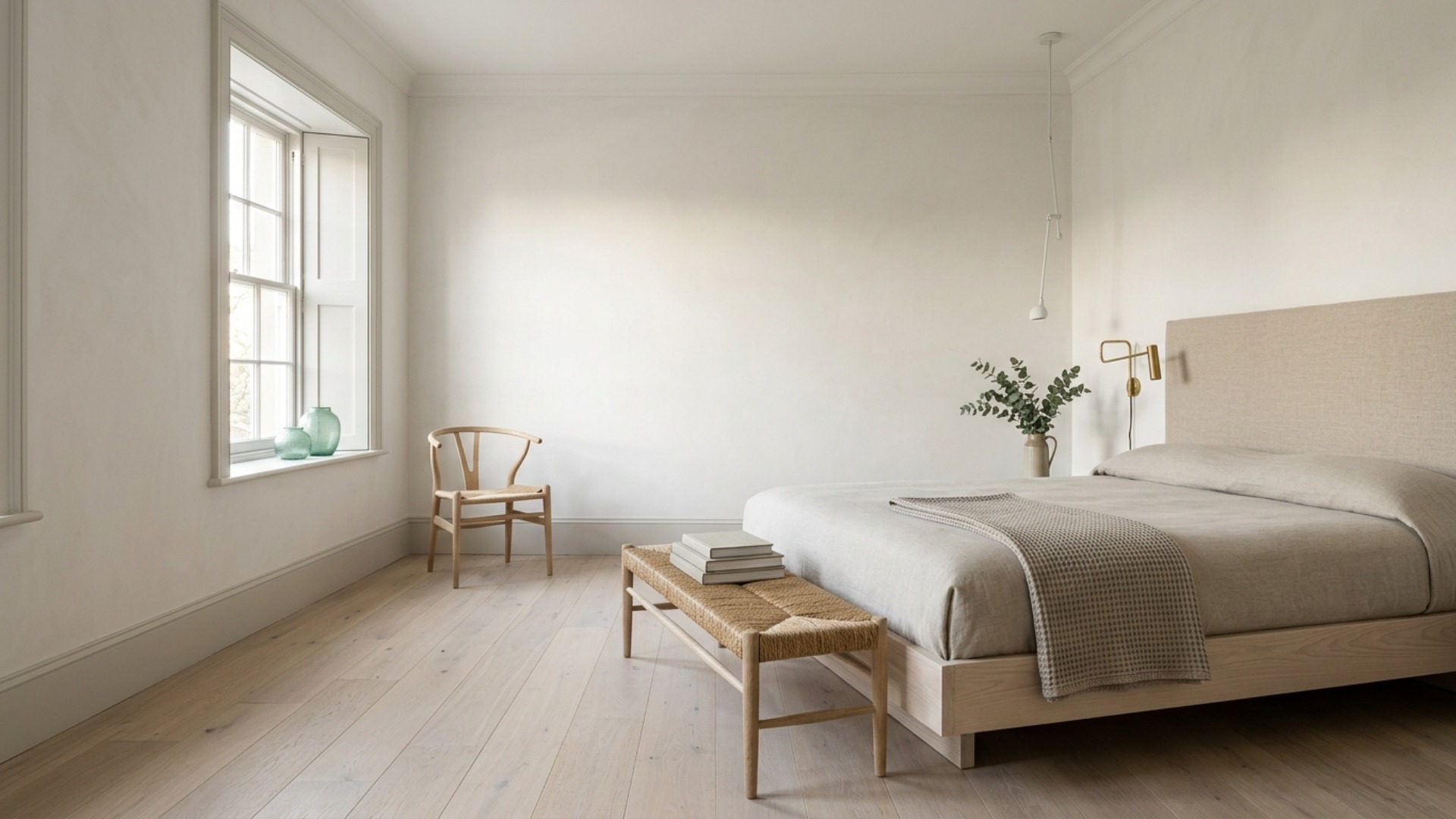
- Palette: chalky off white on walls and ceiling, bleached ash and oatmeal through the middle, one sea glass green accent.
- Materials: limewashed plaster, bleached or soaped oak, heavy washed linen, woven rush, jute, unlacquered brass.
- Signature: the wall colour carried onto the ceiling and the woodwork, so the room reads as one continuous surface.
- Bed: a low pale frame with an upholstered linen headboard, and bedding in three shades of one colour rather than a pattern.
- Texture: rush matting, a waffle throw, and a slubby linen curtain doing the work pattern would do in another style.
- What to skip: navy and rope, driftwood lettering, glossy white lacquer, and any grey with a blue undertone.
Use it for
What people plan with Framehouse
- Test a warm off white against your actual bedroom light before buying paint
- Compare a double and a king in the room before you order a bed
- See how a low pale frame reads against a tall upholstered one
- Size a rug against the bed instead of guessing from a listing
- Show a partner what the finished room will feel like before anything is bought
Quick answers
Common questions
Make a plan you can act on
Skip the spiral of mood boards. Three minutes in the Aura Quiz turns your taste into a direction.
Take the Aura Quiz