Modern Farmhouse Bedroom Ideas for an Empty Room
A bedroom is the one room where modern farmhouse can go badly wrong without anyone noticing, because the style photographs beautifully and sleeps terribly if you get the light wrong. This page covers what to decide while the room is still empty, what actually makes the style read, and which parts of it to leave in the shop.
The real problem
Why this is harder than it looks
Modern farmhouse is a daylight style. It was worked out for rooms with big windows and pale walls, and almost every photograph you have seen of it was taken at eleven in the morning. A bedroom is used mostly in the dark, which is why the version people build from those photographs so often feels flat at night: all the warmth was coming from the sun, and nobody replaced it.
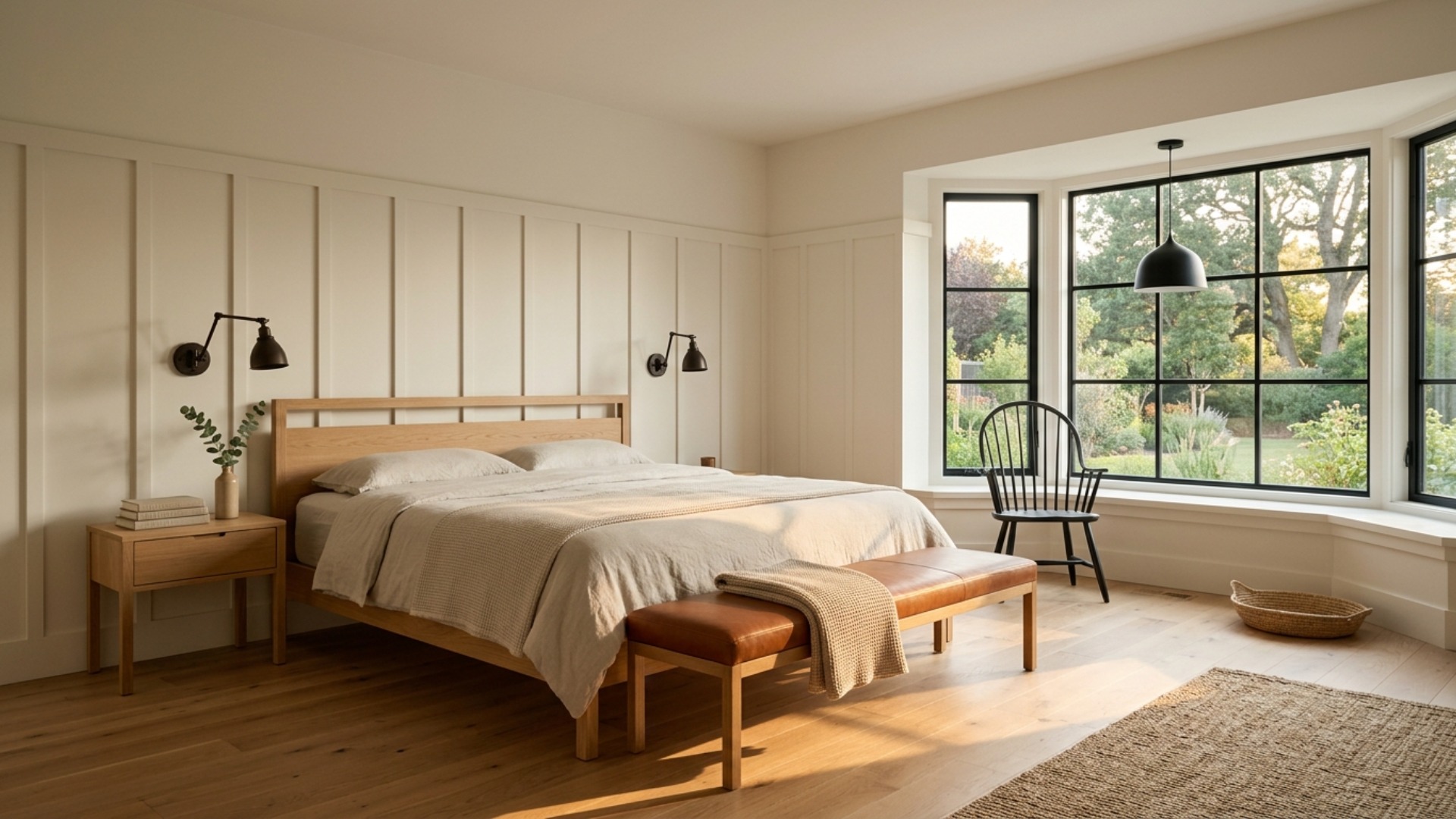
Underneath, the style runs on a very simple structure. One large area of quiet architectural texture, usually panelling on a single wall, one honest wood, and black metal used as punctuation. That structure is what makes a modern farmhouse bedroom read as calm rather than plain, and it is almost entirely a decision about which wall gets the attention and which walls stay silent.
The particular gift of an empty bedroom is that the bed has not been placed yet. Where the bed goes determines the panelling, the sconce positions, the socket positions, and whether you spend every morning with light in your face. In an occupied room, changing it means moving everything. Right now it costs nothing, and it is the only decision on this page that is genuinely difficult to undo.
The failure pattern is the style arriving as a set of props. A sliding barn door, a reclaimed sign, a galvanised watering can on a shelf, and a headboard in three different woven materials. None of that is the style, and in a bedroom it actively works against the calm the room is supposed to deliver. A modern farmhouse bedroom needs one textured wall, one wood, warm light, and good linen. The rest is decoration standing in for design.
A clear path
How to plan it
-
01
Choose the bed wall before anything is bought or painted
Walk the empty room and pick the wall the bed will sit against, then check what you will be looking at when you lie down and where morning light lands. The bed usually wants the wall opposite or perpendicular to the window rather than under it, so you are not waking up into direct sun. Mark the head position on the floor with tape, because the panelling, the sconces, and the sockets all follow from it.
-
02
Panel one wall and leave the other three alone
This is the move that carries the whole style and it is a weekend of work in an empty room. Vertical board and batten behind the bed, taken up to about 1.2 metres or to picture-rail height, then painted the same warm off-white as the rest of the room. Painting it the same colour rather than picking it out in contrast is what separates the current version of this style from the 2016 version, and it costs about $200 in timber.
-
03
Put the light at bed height and get it warm
A single ceiling fitting will make a modern farmhouse bedroom look flat after dark no matter how good the daylight version is. Fit a pair of swing-arm sconces in oil-rubbed bronze or matte black either side of the bed, about 1.5 metres from the floor, and wire them while the wall is open. Everything on 2700K, on a dimmer if you can. This is the single biggest difference between a bedroom that photographs well and one that feels good to be in.
-
04
Spend the textile budget on bedding and one rug underfoot
With the walls quiet, the textiles are doing the visible work. Washed linen or heavy cotton in oatmeal, warm white, or a muted sage, plus one waffle-weave or wool blanket folded across the end of the bed. Then a wool or jute rug large enough to run at least 60 centimetres past each side of the bed, which for a queen usually means 240 by 300 and not the 160 by 230 that looks right in the shop.
-
05
See the room before the bed and rug are ordered
A bed and a rug are the two most expensive things in this room and the two hardest to return. Photograph the empty bedroom and use Framehouse to check the wall colour against your floor, the bed scale against the wall, and the rug size in place before ordering. Warm off-whites in particular shift a great deal depending on what the floor is doing, and a paint chip held against bare boards will not tell you.
Built for empty room design
Moves that pay off
An empty bedroom lets you work in the right order for once, which in practice means doing the invisible things first.
- Wire the sconces and add sockets at each side of the bed before you paint. Retrofitting either means opening the wall you just finished.
- Sort blackout while the window is bare. A recessed blind track or a ceiling-mounted curtain track is easy now and awkward later.
- Buy the mattress first and separately. It has nothing to do with the style and everything to do with whether the room is worth having.
- Panel and paint before any furniture arrives. The same job takes twice as long around a bed and never quite finishes at the skirting.
- Hold off on the headboard. It is the most style-specific purchase in the room, and a panelled wall often removes the need for one entirely.
- Leave the nightstand surfaces empty for the first month, so you can see what genuinely needs to live there before you buy storage for it.
modern farmhouse cues
What to keep, what to skip
Modern farmhouse is warm neutrals plus one architectural texture. In a bedroom the warmth has to survive after dark.
- Palette: a warm creamy off-white on walls and panelling, natural or white oak for the wood, black or oil-rubbed bronze metal, and one muted accent such as sage, cognac, or charcoal.
- Materials: painted board and batten or shiplap, honest oak with visible grain, washed linen, wool, saddle leather, matte black steel. Nothing distressed on purpose.
- Structural signature: one panelled wall behind the bed, painted the same colour as the room, with everything else left plain.
- Light is part of the style, not an afterthought. Two warm sources at bed height beat one bright source overhead every time.
- Keep the wood tone singular. One oak across bed, nightstands, and floor reads considered, three browns reads accidental.
- What to skip: barn doors, script signs, galvanised metal, faux distressing, mixed woven headboards, and anything sold as farmhouse decor.
Use it for
What people plan with Framehouse
- Check where morning light lands before fixing the bed position
- Test a warm off-white on panelling against your bare floorboards
- See whether a 240 by 300 rug actually fits around the bed
- Compare a panelled bed wall against a plain one with a headboard
- Show a partner the finished room before the bed is ordered
Quick answers
Common questions
Make a plan you can act on
Skip the spiral of mood boards. Three minutes in the Aura Quiz turns your taste into a direction.
Take the Aura Quiz