Modern Farmhouse Home Office Ideas for an Empty Room
A spare room you have not furnished yet is the best office you will ever get, because you can put the desk where the work goes rather than where the leftover furniture allowed. This page covers how to place it, what modern farmhouse actually needs in a working room, and the parts of the look that quietly make a room worse to work in.
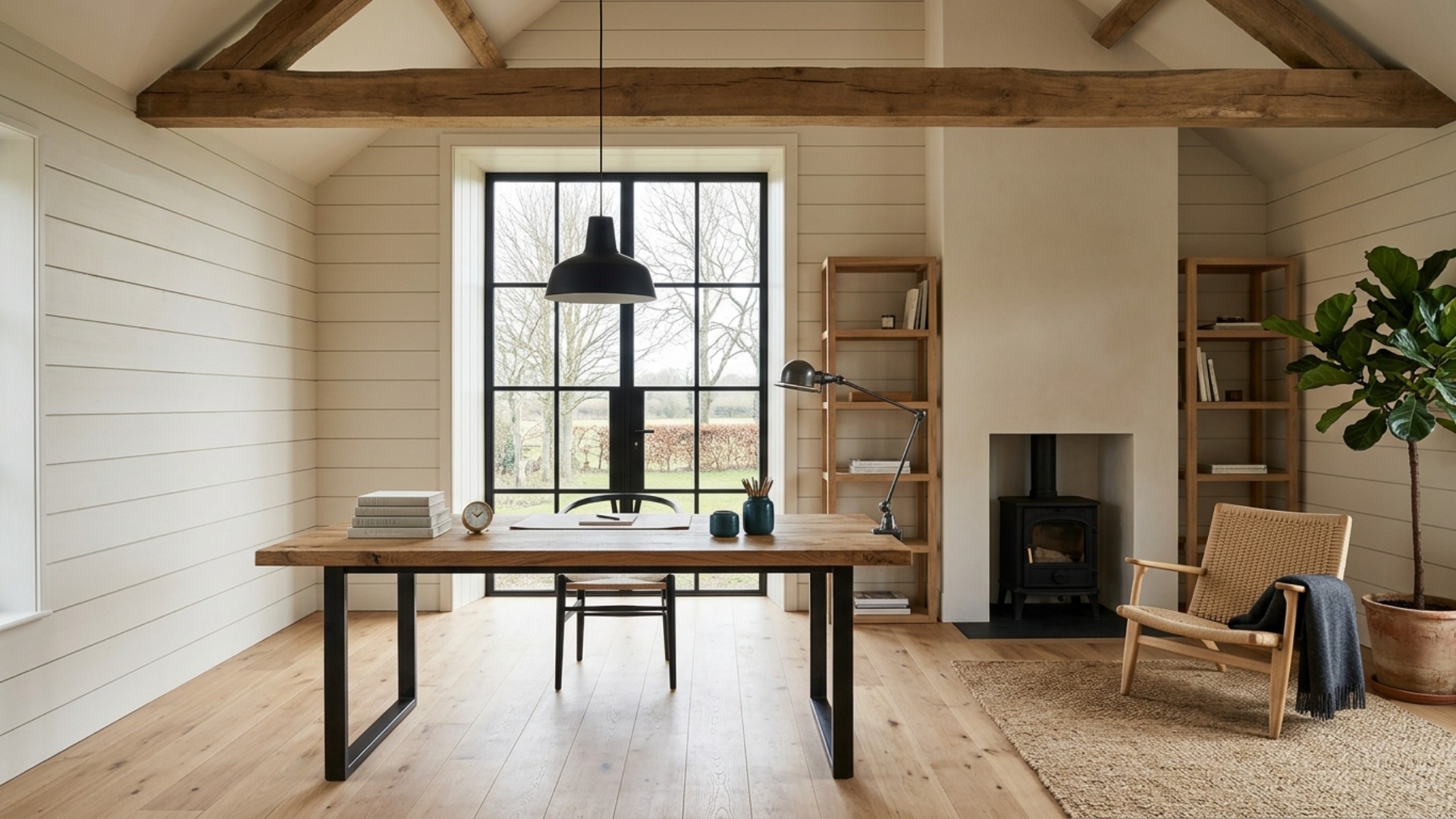
The real problem
Why this is harder than it looks
Modern farmhouse is the most bought and least understood style in a home office, because most people arrive at it through a mood board of finished rooms rather than through the logic underneath. The shiplap and the black window frames are the visible half. The half that makes those rooms work is that they are almost always built around one strong horizontal line and a lot of plain wall, which is a discipline, not a purchase.
In a home office that discipline matters more than it does anywhere else in the house, because an office fills up. Cables, paper, a printer nobody wants to look at, the second monitor, the box of things that has no home. A living room can absorb a bit of visual noise. A room you sit in for eight hours cannot, and the moment the plain wall disappears behind pinboards and open shelves, the style goes with it.
The specific advantage of starting empty is that you get to choose where the desk faces before anything else is decided, and that single choice determines the light, the video call background, and whether you spend the day looking at a wall. Almost every underwhelming home office in an older house is one where the desk went into the gap that was left, usually against the only unbroken wall, facing away from the window.
The failure pattern here is decoration standing in for the style. A sliding barn door on a room that never needed one, a galvanised bucket, a framed sign about coffee, a woven basket in every corner. Modern farmhouse in a working room is carried by three things: the wall colour, one honest wood, and black metal used sparingly. Everything sold in the farmhouse aisle beyond that is working against you.
A clear path
How to plan it
-
01
Place the desk before you decide anything else
Stand in the empty room at the hour you actually work and put the desk where the light falls across the surface rather than into your eyes or behind your head. In practice that is usually side-on to the window, roughly a metre back from it. Check the wall behind you at the same time, because it is your video call background for the next several years, and a plain shiplap wall does that job better than a bookcase.
-
02
Paint the room before a single thing goes into it
An empty room is the only time painting is a two hour job rather than a two day one, and paint carries most of the modern farmhouse feeling on its own. Benjamin Moore White Dove or Farrow and Ball Wimborne White give the warm creamy off-white the style needs. Avoid a blue-based white, which turns cold under screen light, and avoid a dark accent wall behind the desk, which reads heavy on camera and eats the light you just worked to keep.
-
03
Buy one large piece of closed storage, not shelving
Open shelves are the standard farmhouse move and the wrong one in an office. Get a single tall cupboard or a run of base cabinets with doors, roughly 1.2 metres wide, and let it swallow the printer, the cables, the paper, and the box of things. A reclaimed oak or painted shaker cupboard at $400 to $900 does more for the room than $900 of styled open shelving, because the calm of the style depends on what is not visible.
-
04
Use black metal in exactly three places
Black is what stops modern farmhouse turning soft and beige, but it works by contrast, so it has to be rationed. Pick three: the window frames or a slim internal reveal, the desk legs or a task lamp, and the door hardware. A matte black Jielde or Anglepoise clamp lamp covers one of the three and is genuinely better to work under than a ceiling light. Beyond three, the room starts reading industrial rather than farmhouse.
-
05
Test the whole room before you commit to the desk
A desk is the one piece here that is expensive, heavy, and awkward to return, and scale is very hard to judge in an empty room, which always reads larger than it is. Photograph the room and use Framehouse to see the desk size, the wood tone, and the wall colour together before ordering. It also lets you check the version people rarely test in advance, which is what the room looks like from the doorway rather than from the chair.
Built for empty room design
Moves that pay off
An empty room is a rare chance to sequence the work properly rather than fixing things around furniture that is already in place.
- Sort the power first. Work out where the desk goes, then add sockets there, ideally a double at desk height, before anything is painted.
- Deal with the floor while the room is clear. Sanding or laying anything in an empty room costs a fraction of doing it later.
- Buy the chair before the desk. It is the piece your body notices and the one people most often leave until the budget has run out.
- Resist filling the walls. An empty wall behind the desk is not an unfinished wall, it is the thing that makes the room photograph and feel calm.
- Live in it for a fortnight before hanging anything. Where you actually need a shelf is rarely where the plan put one.
- Keep the door swing clear. A spare room is usually small, and a door that hits the chair is the fastest way to end up hating the layout.
modern farmhouse cues
What to keep, what to skip
Modern farmhouse is a warm palette plus restraint. In a working room the restraint is doing most of the work.
- Palette: a warm creamy off-white on the walls, natural or reclaimed oak for the wood, black metal as the accent, and one soft textile in linen or wool.
- Materials: painted shiplap or plain plaster, honest oak with visible grain, matte black steel, natural woven fibre. Nothing distressed on purpose.
- Structural signature: one strong horizontal line, usually the shiplap run or a picture rail, carried around the room uninterrupted.
- Wood tone should stay consistent. One oak across desk, shelving, and floor reads intentional. Three different browns reads like a house clearance.
- Keep at least one wall completely bare. This is the single cue most people skip and the one that separates the real thing from the catalogue version.
- What to skip: barn doors on rooms that do not need them, script wall signs, galvanised anything, faux distressing, and Edison bulbs.
Use it for
What people plan with Framehouse
- Check whether the desk fits side-on to the window before ordering
- See a warm off-white against your existing floor before buying paint
- Compare a painted cupboard against open shelving behind the desk
- Show a partner the finished room before the spare room gets committed
- Test what the video call background actually looks like from the desk
Quick answers
Common questions
Make a plan you can act on
Skip the spiral of mood boards. Three minutes in the Aura Quiz turns your taste into a direction.
Take the Aura Quiz