Minimalist Living Room Ideas for a Family Home Refresh
Minimalism is usually sold as owning less, which is why families give up on it within a week. The version that survives children is about closed storage, a short material list, and how many surfaces you leave visible, and this page covers how to refresh a family living room around exactly that.
The real problem
Why this is harder than it looks
The reason minimalism has a bad reputation in family houses is that it gets explained as a quantity problem. Own less, buy less, throw more away. That advice collapses on contact with two children, a games console, and a school bag, and once it collapses people conclude the style is not for them. It is a misreading of what makes those rooms look the way they do.
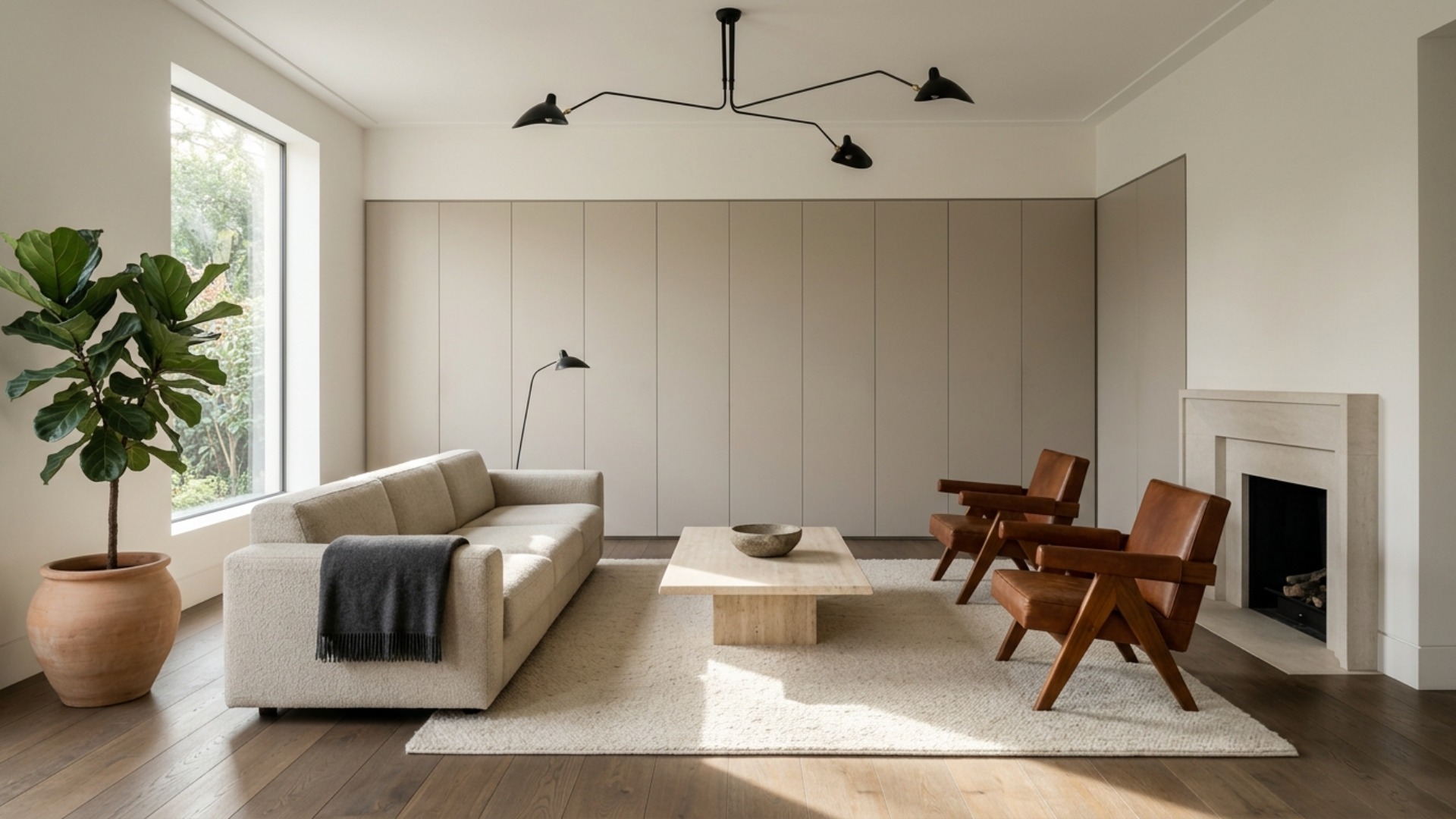
What is actually going on is a visibility problem, not a quantity problem. A minimalist room is not one that contains few objects, it is one where very few objects are in view at any moment and where the ones that are share a short list of materials. A family of four can run a genuinely minimalist living room with a hundred things in it, as long as ninety of them live behind a flat door. The discipline is in the storage plan and the palette, not in the purge.
A family home refresh puts you in a particular starting position, and it is a better one than you probably think. The furniture is already there, the room already works for how you live, and the sofa is probably fine. What has usually happened over five or eight years is accumulation at the edges: three different wood tones, four throw blankets that were each a good idea once, open shelving that started as display and became storage, and a rug that has quietly given up. None of that requires a renovation to fix.
The failure pattern is the one that follows a Saturday of enthusiasm. Everything gets removed, the room goes bare and slightly cold, nobody wants to sit in it, and within a month the clutter comes back with nothing designed to catch it. Minimalism in a family room fails when subtraction happens before the storage exists. Build somewhere for the mess to go first, then take things away, and it holds.
A clear path
How to plan it
-
01
Count your visible surfaces and cut them by half
Walk the room and count every horizontal plane that can hold an object: coffee table, console, windowsill, two side tables, open shelves, the floor beside the sofa. In most family living rooms it is nine or ten, and each one generates clutter simply by existing. Removing three or four of them does more for the room than any purchase, and it costs nothing.
-
02
Buy the closed storage before you take anything away
The single piece that makes a minimalist family room possible is a long low run of flat-front cabinetry, ideally wall to wall and no higher than about 60 centimetres, holding toys, controllers, chargers, and games. Handleless or with a simple recessed pull, in a matte finish that matches the wall rather than contrasting with it. This is worth spending real money on, roughly $800 to $2,500 built or assembled, because it is the thing doing the work.
-
03
Cut down to one wood tone and two textiles
Most family living rooms have quietly accumulated three or four wood tones and a drawer of unrelated cushion covers. Pick one wood, warm smoked oak and walnut both work, and either replace or ignore the pieces that fight it. Then choose two textiles for everything soft, for example a heavy oatmeal wool and a charcoal cotton, and let every cushion and throw come from those two.
-
04
Spend on material quality rather than on more objects
A minimalist room has nowhere to hide, so the few things in view have to be good. That usually means a performance wool or a tight boucle on the sofa rather than a loose weave, a solid stone or solid timber coffee table instead of veneer, and a wool rug that can be scrubbed. One well made object earns its place in a bare room. Three mediocre ones read as unfinished.
-
05
Test the empty version before you commit to it
Bare rooms are genuinely hard to picture, which is why so many people overshoot into cold. Photograph the living room and use Framehouse to see what it looks like with the shelving gone, one wood tone, and a single large plant, before you sell furniture or order cabinetry. It is also the cheapest way to settle an argument about whether the room will feel calm or clinical.
Built for family home refresh
Moves that pay off
A family home refresh is an edit of a room that already works, not a rebuild. Protect what is functioning and fix the accumulation around it.
- Do the storage first and the subtraction second. Removing clutter with nowhere for it to go guarantees it comes back within a month.
- Keep the sofa if it is comfortable and the frame is sound. Reupholstery in a heavy performance wool costs far less than replacement and fixes the look completely.
- Choose one drawer or basket per person as the overflow rule. Anything that does not fit gets dealt with rather than left on a surface.
- Do not go white on the floor or the seating. Minimalism in a family room needs mid tones that hide life, not pale ones that document it.
- Deal with the cables in the first pass. Nothing undoes a restrained room faster than four black wires down the wall.
- Leave one wall completely empty and resist filling it. That empty wall is doing as much for the room as any piece of furniture in it.
modern minimalist cues
What to keep, what to skip
Minimalism holds together through restriction and repetition. Fewer materials used more often, not fewer things in total.
- Palette: two neutrals and one grounding dark. Chalk white or warm greige on the walls, a mid tone for the seating, and soft black in the lighting and hardware.
- Materials: matte lacquer or painted MDF for storage, one solid wood, one stone such as travertine or limestone, heavy wool, and nothing high gloss anywhere.
- Structural signature: long uninterrupted horizontal lines. A low wall to wall run of cabinetry, a long low sofa, and a level sightline with nothing tall breaking it.
- One focal material carries the room, usually the stone or the timber. Choose it, use it in two places, and let everything else stay quiet behind it.
- Scale up rather than out. One large plant, one large artwork, and one large rug read as calm. Six small versions of the same things read as clutter.
- What to skip: open shelving in the main sightline, gallery walls, decorative trays, three-metal hardware mixes, and anything bought purely to fill a corner.
Use it for
What people plan with Framehouse
- Test a wall to wall storage run against your actual room width
- See the living room with the open shelving removed before you take it down
- Compare smoked oak and walnut against the floor you already have
- Check whether a mid tone sofa reads calmer than the pale one you are considering
- Show the whole family the plan before anything gets thrown out
Quick answers
Common questions
Make a plan you can act on
Skip the spiral of mood boards. Three minutes in the Aura Quiz turns your taste into a direction.
Take the Aura Quiz