Mid Century Modern Home Office Ideas for a Luxury Upgrade
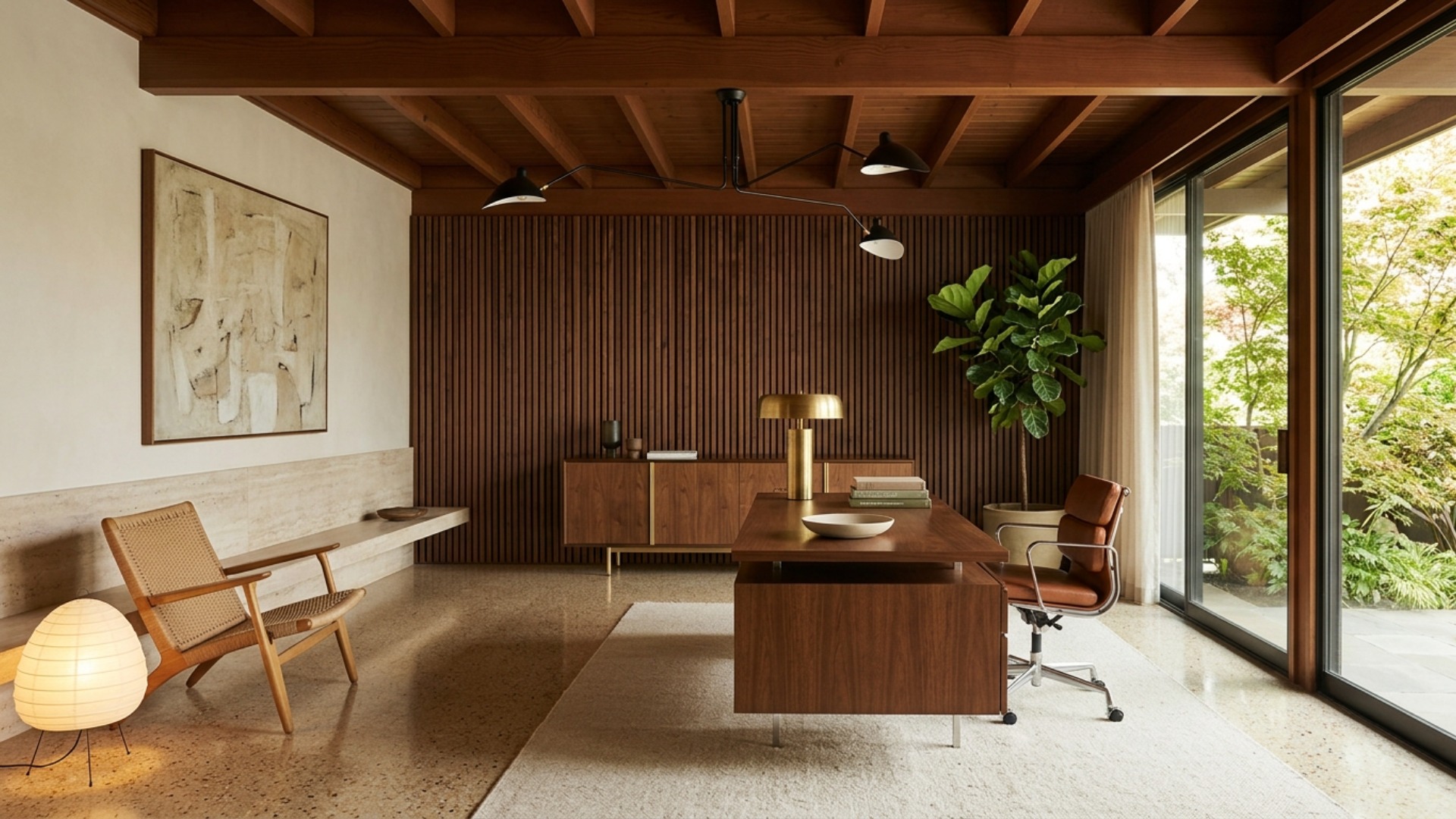
Mid century modern is the easiest style in the world to spend serious money on badly, because the reproductions look right in a photograph and wrong in a room. This is where the budget actually goes in a home office, and what to leave alone.
The real problem
Why this is harder than it looks
At this budget the problem stops being taste and starts being provenance. There are three tiers of almost every canonical piece: the licensed original from Herman Miller, Knoll or Carl Hansen, the vintage piece from the period, and the reproduction that costs a fifth as much and photographs nearly the same. The reproduction is not a moral failure, but it is a proportional one. Manufacturers change the seat height, thicken the arm, swap the wood veneer, and each small deviation is invisible alone and obvious once the room is assembled.
Underneath the shopping, mid century modern is a discipline about proportion and one wood. The furniture was designed low, for eight foot ceilings and small mid century rooms, and it reads as elegant precisely because everything sits below the eye line. Drop a modern high back office chair or an oversized sectional into that vocabulary and the whole room loses its horizontal calm. The second discipline is the wood. One species, held across the desk, the credenza and the shelving, with everything else in leather, cane, textile or metal.
The home office has its own problem that no living room has: the equipment. A Nakashima desk with a black plastic monitor arm, a nest of white cables and a mesh task chair reads as a home office that happens to own a beautiful desk. That is the difference between an expensive room and a designed one, and it costs almost nothing to fix relative to the furniture budget.
The failure pattern at this tier is the set. Someone buys the desk, the credenza, the lounge chair and the lamp from one dealer in one afternoon, all in the same walnut, and produces a very costly showroom. Mid century interiors that hold up mix a period piece with a contemporary one, and let something in the room be plainly of now.
A clear path
How to plan it
-
01
Pick one wood species and hold it across every case piece
Walnut is the default for a reason: it warms under lamplight and it was the period species. Whatever you choose, the desk, the credenza and any shelving should be the same wood, and everything else in the room should be leather, cane, wool, marble or metal. Two competing wood tones is the single most common reason a well funded mid century room reads slightly off.
-
02
Buy the chair you sit in before the one you look at
An Eames Soft Pad Executive Chair in aniline leather is around $6,000 and is genuinely comfortable for a four hour stretch, which the Lounge Chair and Ottoman is not. If you work eight hour days, buy the ergonomic chair you actually need and put the sculptural piece in the reading corner instead. Nobody has ever regretted this order and plenty of people have regretted the reverse.
-
03
Solve the equipment before the desk arrives
Run a matte black or brass monitor arm rather than the stock plastic stand, get a single cable channel under the desk, and choose a keyboard and mouse that are not glossy white. A $200 accessory decision determines whether a $9,000 desk looks like furniture or like a workstation. If the desk floats away from the wall, which is the right instinct, this matters twice as much because the back is visible.
-
04
Add exactly one period lighting piece
A Serge Mouille three arm ceiling lamp, a Nelson Bubble pendant, or a Noguchi Akari floor lantern will do more for the room than a second chair. One is a statement, two is a theme, and three is a reproduction of a museum. Keep the rest of the lighting recessive and warm, and put everything on a dimmer.
-
05
See it assembled before you place the orders
Licensed mid century pieces run eight to sixteen weeks and are rarely returnable, so this is the scenario where seeing the room in advance is worth the most. Photograph the space and run it through Framehouse to test walnut against your floor, the wall colour behind the credenza, and whether the desk really wants to float, before a single lead time starts.
Built for luxury upgrade
Moves that pay off
A luxury upgrade is a decision about where the money stops being visible. Six things worth knowing before you order.
- Spend on the pieces you touch: the task chair, the desk surface, the rug. Spend less on shelving and side tables, where the difference is invisible.
- Buy licensed or vintage for anything canonical and sculptural. Buy contemporary and unbranded for anything purely functional.
- Assume eight to sixteen weeks on licensed pieces and plan the room to be usable in the meantime. Order the chair first.
- Vintage is often cheaper than licensed and better made, but budget for restoration: a period Wegner usually needs new paper cord and an oil refinish.
- Do not buy a matched set from one dealer in one visit. Rooms assembled in a single afternoon look assembled in a single afternoon.
- Leave the art until last, and buy one large piece rather than three medium ones. Mid century rooms want a single strong horizontal.
mid century modern cues
What to keep, what to skip
Mid century modern is a proportion discipline before it is a shopping list. Six rules worth holding.
- Palette: walnut or teak, warm off white walls, and one or two saturated accents. Deep olive, cognac, mustard and burnt orange all belong. Cool grey does not.
- Materials: solid walnut, aniline leather, paper cord, cane, travertine, brushed brass, wool boucle, terrazzo.
- Structural signature: everything sits low and horizontal. Tapered legs, visible frames, furniture that shows its own construction rather than hiding it.
- Lighting: one sculptural period fixture, warm bulbs, dimmers everywhere. Never a bright overhead as the only source.
- Let one thing in the room be contemporary. A mid century interior with no present tense in it reads as a set.
- Skip: the full theme room, starburst clocks, atomic prints, and any piece described as mid century inspired at a price that makes that plausible.
Use it for
What people plan with Framehouse
- Test walnut against your existing floor before ordering a desk with a twelve week lead time
- See whether the desk should float in the room or sit against the wall
- Compare a licensed piece against a vintage alternative in the same space
- Show a partner what the finished study will look like before six figures of orders go in
- Decide the wall colour behind the credenza without painting three test patches
Quick answers
Common questions
Make a plan you can act on
Skip the spiral of mood boards. Three minutes in the Aura Quiz turns your taste into a direction.
Take the Aura Quiz