Modern Farmhouse Home Office Ideas for a Luxury Upgrade
Modern farmhouse at a higher budget does not mean more of the same things in better materials. It means removing the shortcuts the mass market version depends on and letting real construction show.
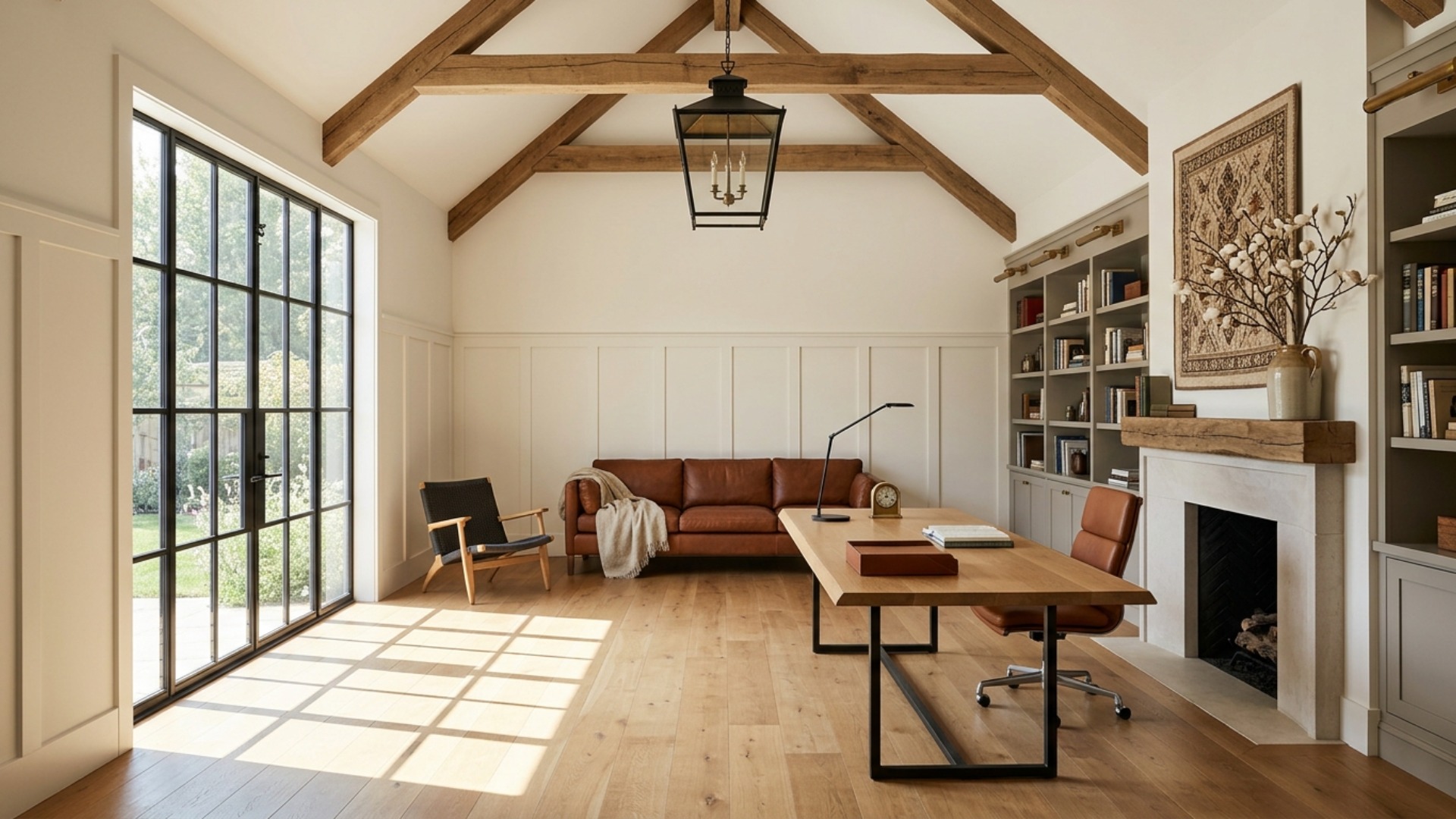
The real problem
Why this is harder than it looks
Modern farmhouse got popular fast and got cheap fast, and the cheap version is now what most people picture: thin MDF shiplap, a sliding barn door on a wall that never needed one, black grid windows that are actually vinyl with a grid stuck between the panes, and a word painted somewhere. None of that is a style problem. It is a materials and construction problem wearing a style's clothes.
What the original references actually have is honest structure. Real timber that carries load, plaster with depth to it, windows with genuine slim steel sections, joinery with visible craft. The look reads as calm and generous because everything in it is what it appears to be. That is also why the upgrade path is unusually clear here, clearer than for most styles: you are not adding decoration, you are replacing the imitation of a thing with the thing.
At this budget the specific trap is different from the one a first time decorator faces. You can afford everything, and the temptation is to buy all of it. A vaulted ceiling with reclaimed beams, plus board and batten, plus a limestone fireplace, plus a barn door, plus an apron sink in the coffee nook, and the room reads as a catalogue of farmhouse signifiers rather than a room. Restraint is the expensive part.
The common failure pattern is spending upward on the visible items and leaving the substrate alone. New oak floors laid over a subfloor that squeaks, a beautiful desk under a flat builder grade ceiling, a $9,000 window in a wall with no insulation behind the plaster. The upgrade shows in the first photograph and disappoints every day after.
A clear path
How to plan it
-
01
Spend on the ceiling before you spend on furniture
In this style the ceiling is the single highest leverage surface, and it is the one most renovations leave alone. Opening to the rafters, or adding real structural collar ties in reclaimed oak, changes the room more than any desk will. Budget $6,000 to $20,000 depending on structure, and get a structural engineer involved before a carpenter.
-
02
Replace the windows with genuine steel, or leave them alone
The black grid window is the load bearing element of this look and also the most commonly faked. Real slim profile steel from a maker like Crittall runs roughly $150 to $250 per square foot installed. A thermally broken aluminium equivalent is a legitimate compromise at about half that. Vinyl with an internal grid is not, and at this budget it undercuts everything else in the room.
-
03
Choose one wall treatment and give it real depth
Wide flat board and batten to dado height, in solid poplar with a 5/8 inch stand off, reads completely differently from thin MDF applied to drywall. Pick either that or plaster, never both plus shiplap. If plaster, specify a hand troweled lime finish rather than a rolled texture, since the depth is the entire point and it is invisible in photographs but obvious in person.
-
04
Buy one very good piece of furniture and let it be the only expensive one
A solid oak partners desk with real joinery, or a single aniline leather chair that will patina, will carry the room. Spend $4,000 to $9,000 there and buy everything else sensibly. A room with one genuinely excellent object and several modest ones reads far better than a room where everything cost the same amount.
-
05
Model the room before you commit to structural work
This is the scenario where visualizing first saves the most money, because the decisions are large and largely irreversible. Photograph the space, run it through Framehouse in a modern farmhouse direction, and compare the vaulted version against the flat ceiling, and the board and batten against plain plaster. Ten minutes here against a five figure quote is a straightforward trade.
Built for luxury upgrade
Moves that pay off
A luxury upgrade is mostly a sequencing problem. Money spent in the wrong order gets torn out later, and the items that hold their value are rarely the ones that photograph best.
- Do everything behind the walls first. Insulation, wiring for the lighting plan, acoustic treatment between floors, and any structural opening. None of it shows and all of it is unaffordable to retrofit.
- Put the lighting plan before the light fixtures. Circuits, dimmers, and switch positions cost little at rough in and are close to impossible to change afterwards.
- Buy one antique or genuinely old piece. The style depends on age reading as real, and a room of new things made to look old is the failure mode that money makes worse rather than better.
- Skip the barn door unless the opening genuinely needs one. It is the single clearest tell of the mass market version and it is also poor at sound isolation for an office.
- Specify unlacquered brass and let it patina. Lacquered brass stays uniformly shiny, which is exactly the quality this style is supposed to be moving away from.
- Hold back roughly fifteen percent of the budget for after you have lived in it. The right rug and the right chair are much easier to choose in a finished room.
modern farmhouse cues
What to keep, what to skip
The elevated version of this style is defined more by what it refuses than by what it includes.
- Palette: warm white walls, honeyed rift sawn oak, one soft mid tone such as mushroom grey or sage, true matte black on the windows and hardware, and a cognac leather accent.
- Materials: rift sawn white oak, reclaimed elm or oak for beams, honed limestone, hand troweled lime plaster, blackened steel, unlacquered brass, aniline leather, heavy natural linen.
- Everything structural should be structural. Beams that carry load, a mantel that is a single piece of timber, brackets that are doing something. Decorative versions of all three exist and all three read as fake in person.
- The signature move is the tall black steel window, ideally reaching close to the floor. It is the most expensive element and the one nothing else substitutes for.
- Age has to be real somewhere. One antique, one reclaimed timber, one thing with genuine wear, or the room reads as a very expensive imitation.
- Skip the sliding barn door, the thin MDF shiplap, the word signs, the galvanised buckets, and the faux beam that clips over a joist. At this budget these actively cost you.
Use it for
What people plan with Framehouse
- See a vaulted ceiling before you pay a structural engineer to open one
- Compare board and batten against hand troweled plaster in your real light
- Test whether a black steel window changes the room enough to justify the cost
- Show a builder the finished intent instead of describing it in a meeting
- Check how honeyed oak floors read against the mushroom grey you shortlisted
Quick answers
Common questions
Make a plan you can act on
Skip the spiral of mood boards. Three minutes in the Aura Quiz turns your taste into a direction.
Take the Aura Quiz