Mid Century Modern Home Office Ideas for a Rental Makeover
Mid century modern is the most rentable style there is, because it was designed for ordinary small houses and it lives entirely in the furniture rather than the walls. The catch is the shell you were handed, and that is what this page is about.
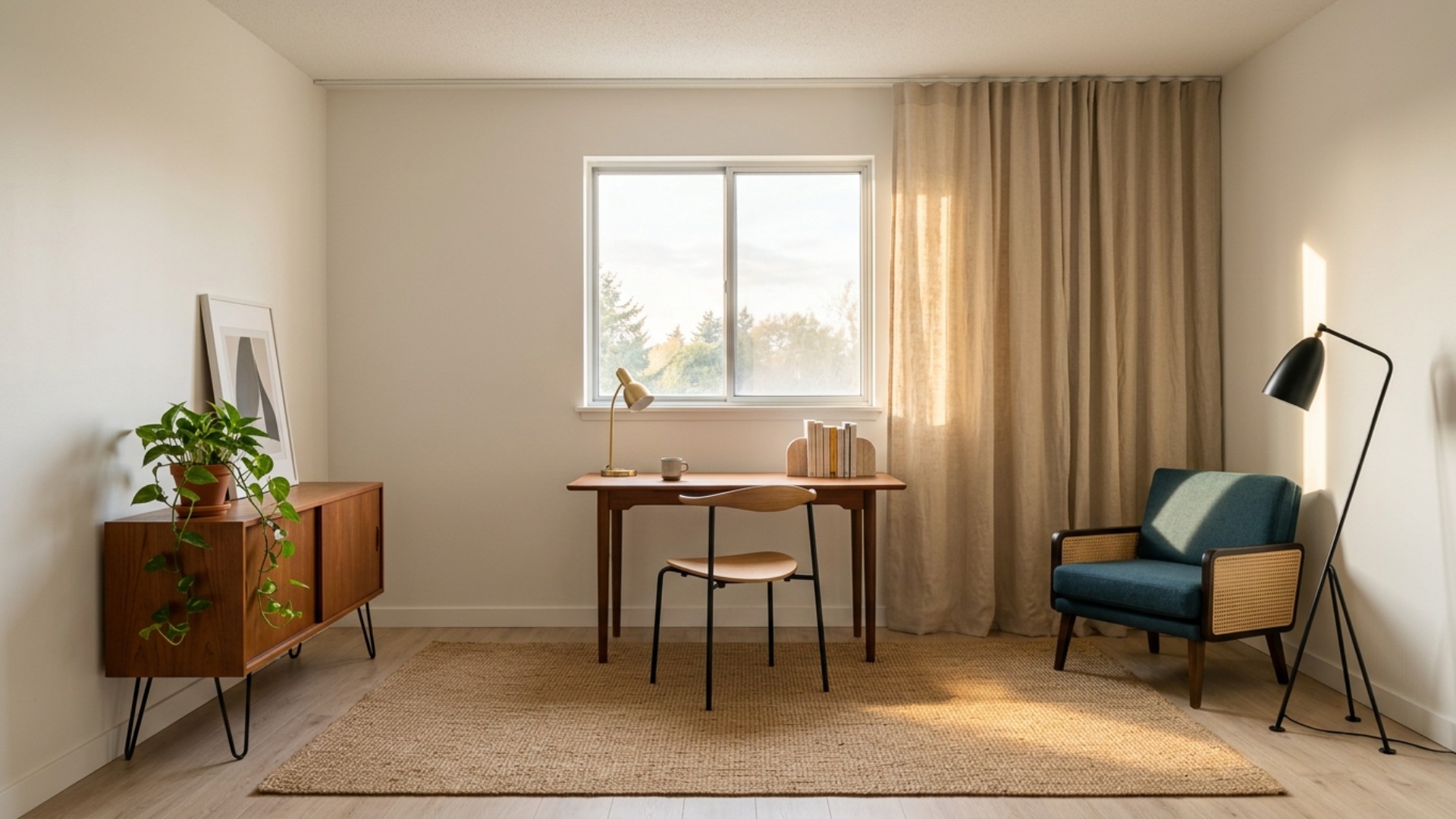
The real problem
Why this is harder than it looks
The renter version of this style fails for a completely different reason than the expensive version. Nobody is agonising over licensed versus reproduction. The room is losing to its own shell: a cool white ceiling fixture, grey laminate or landlord beige carpet, hollow stud walls that will not take a shelf, and paint with just enough blue in it to make every warm wood look muddy. Adding a walnut desk to that room does not fix it, and most advice stops at adding the walnut desk.
The good news is unusually real here. Mid century modern is furniture led rather than architecture led. It was designed for small postwar houses with eight foot ceilings and no mouldings, which is a fairly good description of most rentals. Unlike Parisian, industrial or farmhouse, the style asks nothing of the building. Everything that makes it work is something you can carry out of the door when the lease ends.
Most rental home offices are also a corner of a bedroom or a spare room that already has another job, which means the largest visual problem is usually the light. A single cool white ceiling fixture flattens every wood tone in the room and makes teak look orange and walnut look grey. It is also, in most rentals, the cheapest thing to change and the one people never touch.
The failure pattern is spending the entire budget on the desk and leaving the light, the floor and the window exactly as the landlord left them. The second failure pattern is flat pack furniture with tapered legs bolted onto a particleboard box. That reads as neither mid century nor modern, and a used solid teak piece from a marketplace listing usually costs less.
A clear path
How to plan it
-
01
Deal with the ceiling light before anything else
Either swap the fixture for a simple globe or a small dome and keep the original in a box for move out, which takes twenty minutes and about $60, or leave it switched off permanently and light the room with two plug in sources instead. Whichever route you take, every bulb in the room goes to 2700K. Cool white light is the single reason rental rooms photograph badly and it costs about $15 to fix.
-
02
Put a rug over whatever floor you were given
Grey laminate and landlord beige carpet both disappear under a flat woven jute or a low pile wool rug, and neither needs permission. Size it so the desk chair stays on the rug through its full range of roll, which usually means at least 6 by 9 for a desk against a wall and 8 by 10 if the desk floats. This is the highest impact hundred and fifty dollars in the room.
-
03
Hang the window high and wide without drilling
A tension rod inside the reveal works for narrow windows, and adhesive rod brackets rated for eight pounds handle unlined linen panels on anything wider. Mount as close to the ceiling as the bracket allows and let the fabric break on the floor. Full height curtains are the fastest way to make a standard rental window stop looking like a standard rental window.
-
04
Buy one piece of real solid wood and keep everything else plain
A used solid teak or walnut sideboard from a marketplace listing typically runs $200 to $500 and will outlive three leases, while a new flat pack piece with tapered legs on a particleboard box costs about the same and reads as neither mid century nor modern. Let that one piece carry the wood tone, and let the desk, shelving and chair be plain and inexpensive.
-
05
See the room before you spend, because returns are worse when you rent
Renters usually have no garage to store a mistake in and no easy way to send a sideboard back to a private seller. Photograph the corner you are working with and run it through Framehouse to test teak against your actual floor, whether the desk should face the window or the wall, and how much rug you really need, before any of it is in the room.
Built for rental makeover
Moves that pay off
Renting changes what is worth buying, not how good the room can look. Six rules that keep the deposit and the furniture.
- Buy freestanding, always. Nothing wall mounted, nothing that needs a bracket, nothing sized to one specific alcove.
- Photograph every wall the day you move in. It settles most deposit arguments later and takes five minutes.
- Spend on things that move with you: the rug, the lamps, the wood piece, the chair. Spend as little as possible on anything the landlord will keep.
- Keep the original light fixture, blind and any hardware you remove in a labelled box in a cupboard. Reinstall on the way out.
- Be careful with peel and stick anything on painted walls. It is usually fine on tile and cabinet fronts and it regularly takes paint off drywall.
- Ask before you assume you cannot paint. Many landlords say yes to a neutral repaint in writing, and warm white instead of cool white is the single biggest free upgrade available.
mid century modern cues
What to keep, what to skip
The rental version of mid century modern leans harder on wood and light and much less on architecture. Six things to hold.
- Palette: teak or walnut as the one warm note, plain warm white walls, and a single saturated accent. Petrol blue, olive, mustard and rust all work.
- Materials: solid teak, oiled oak, cane webbing, wool flannel, jute, blackened steel, and linen for the window.
- Structural signature: legs. Everything should stand on visible tapered or hairpin legs so the floor runs underneath, which makes a small rented room read larger.
- Lighting: two plug in sources at different heights, warm bulbs, and the overhead fixture either replaced or left off.
- Lean the art rather than hanging it. A large framed print leaned on a sideboard costs no holes and looks deliberate.
- Skip: particleboard furniture with bolt on tapered legs, starburst wall clocks, and any peel and stick wood panelling on painted drywall.
Use it for
What people plan with Framehouse
- Check whether a teak sideboard reads warm or orange against your grey laminate
- See if the desk should face the window or sit against the wall
- Work out what size rug actually covers the chair roll before ordering
- Test a warm white repaint against the landlord white before asking permission
- Show a housemate or partner the plan before a marketplace pickup you cannot return
Quick answers
Common questions
Make a plan you can act on
Skip the spiral of mood boards. Three minutes in the Aura Quiz turns your taste into a direction.
Take the Aura Quiz