Organic Modern Home Office Ideas for a Rental Makeover
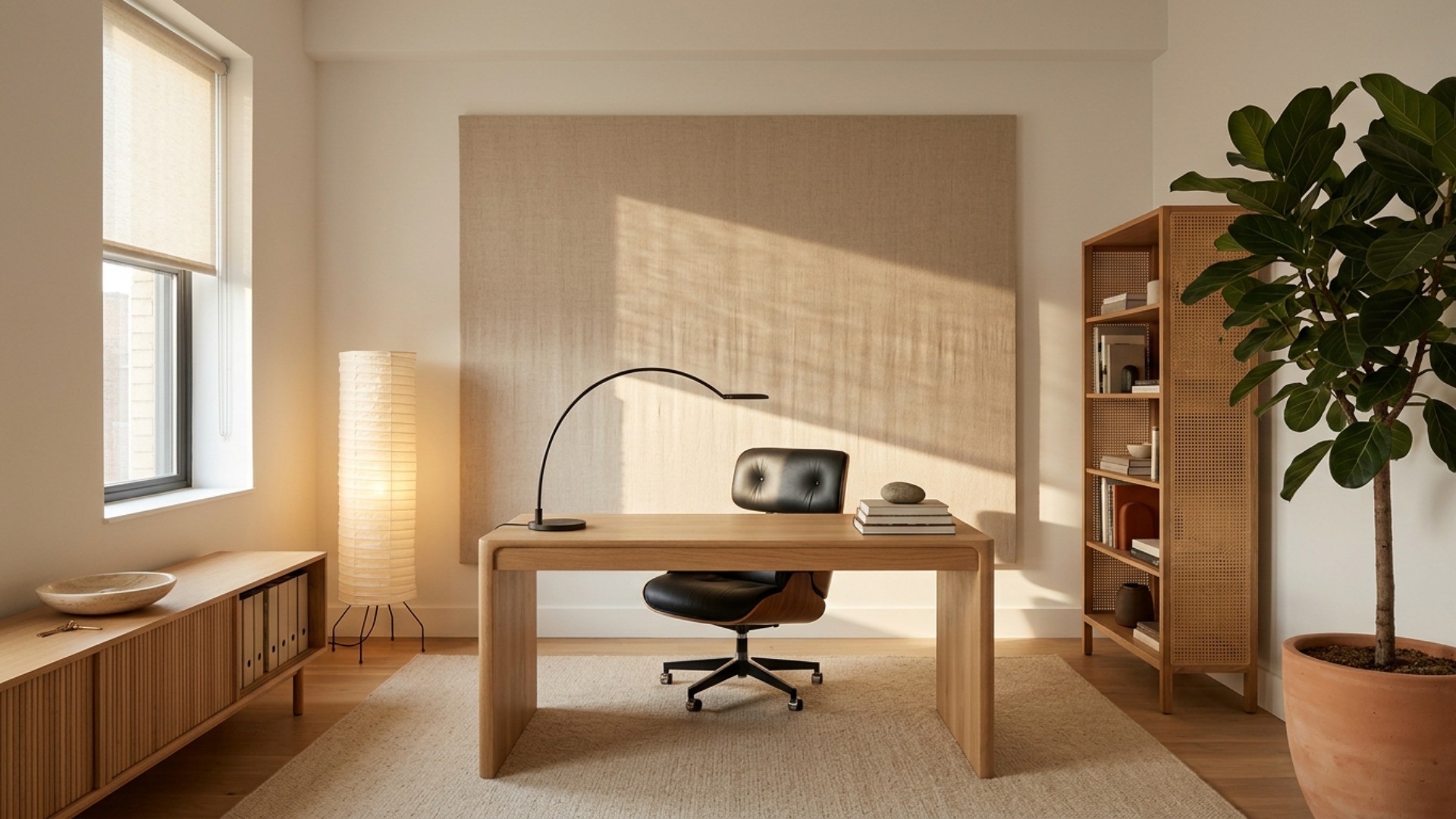
Organic modern is the one contemporary style that does not need a single thing screwed into a wall, which makes it unusually well suited to a room you do not own. This page covers how to build it in a rented home office out of freestanding pieces, textiles, and light.
The real problem
Why this is harder than it looks
Organic modern gets described as warm minimalism, which is close enough to be useless. The more accurate description is that it is a style about softening hard geometry: rounded edges where you expect a corner, hand-finished surfaces where you expect a machine one, and a plant scaled large enough to break the straight lines of the architecture. That is a description of objects and finishes, not of a building, and that is exactly why it survives a rental.
A home office is where this actually pays off. Most desk setups are aggressively rectangular by default: a rectangular desk, a rectangular monitor, a rectangular bookcase, a rectangular window, all in materials chosen by a manufacturer for cost. The room reads as tense, and after eight hours a day that tension is a real thing you feel rather than a design abstraction. Organic modern is a set of instructions for taking that edge off without turning the room into a lounge you cannot work in.
The rental version has one constraint that changes the plan: nothing gets built in, and the wall is off limits. That rules out the floating shelves, the wall-mounted pegboard, and the built-in desk that every organic modern office photo relies on. What it does not rule out is the thing actually doing the work in those photos, which is the material palette. Oiled oak, raw linen, honed stone, matte stoneware, and one large plant will read as organic modern on a folding table, and will not read as anything at all on a beautiful built-in.
The failure pattern here is buying the shapes without the materials. A wavy mirror, an arched shelf, a boucle chair, and a curvy vase in four different finishes gives you a room that looks like it is quoting a trend rather than using one. Organic modern only holds together when the material list is short and repeated, and it falls apart the moment a fifth finish arrives.
A clear path
How to plan it
-
01
Start with the desk surface and pick warm solid wood
Everything else in this room orbits one surface, and a laminate desktop with a grey cast will fight every other choice you make. A solid oiled oak or ash top is the single highest-return purchase, and a bare tabletop on trestles or hairpin legs costs far less than a full desk, usually $180 to $400. If replacing the desk is not possible, a large wood cutting-board style pad or a full-width oak desk mat covers most of what you see.
-
02
Hang a large textile instead of putting anything on the wall
Rental walls are white, cool, and unavailable, and the standard fix of framed prints does almost nothing for this style. A single large panel of raw undyed linen or a plain woven flatweave, hung with removable adhesive strips or a slim tension rod, warms the whole background and quiets the video-call frame behind you. Two metres wide is not too much, and understated beats patterned every time here.
-
03
Get one curve into the room at furniture scale
The style needs a curve big enough to register, not four small ones. A round side table, a soft-edged desk with a radiused front, an arched floor lamp, or a large paper globe lantern all qualify. Pick one, put it where you see it from the desk chair, and then resist adding wavy accessories, since the second and third curves are what tip the room from calm into styled.
-
04
Replace the overhead light with two low warm sources
A single 4000K ceiling panel is the most common reason a rental office looks clinical, and it is also the easiest thing to fix without touching the fitting. Run 2700K bulbs, add a floor lamp in a corner and a small task lamp on the desk, and use the ceiling light as little as possible after dark. Warm light landing on oak and linen is most of what makes these rooms feel the way they do in photographs.
-
05
Test the material mix against your actual walls and floor
Oak reads very differently against a cool builder white than against a warm one, and the wrong pairing is what makes a careful organic modern room look slightly yellow. Photograph the office and use Framehouse to test the wood tone, the linen panel, and the plant scale against your real light before ordering. It is also the quickest way to tell whether the curve you are considering is large enough to actually register.
Built for rental makeover
Moves that pay off
A rental makeover has to look finished now and disappear completely later. Freestanding, reversible, and portable are the three tests every purchase here should pass.
- Buy freestanding and full height rather than mounted. A tall narrow bookcase that leans or stands does the job of floating shelves and comes with you.
- Keep every original bulb and fixture part in one labelled box. That box is worth more than any single item on this page when the deposit is discussed.
- Use adhesive strips rated well above the weight you are hanging, and test one on a hidden patch of wall first. Rental paint quality varies enormously.
- Spend on the desk surface and the chair, since both follow you to every future room and both affect you daily.
- Do not buy a rug for a home office in a pale color. A mid-tone undyed wool hides chair castor wear and will still look right in a living room later.
- Run the cables down one leg with fabric sleeving rather than clipping them to the wall. Visible cabling undoes a calm room faster than anything else in it.
organic modern cues
What to keep, what to skip
Organic modern is a short material list, one large curve, and one plant scaled bigger than feels reasonable. It goes wrong when the shapes arrive without the materials.
- Palette: warm chalk white, oiled oak or ash, raw undyed linen, and one grounding earth accent such as burnt sienna, clay, or deep umber.
- Materials: oiled solid wood, undyed linen and wool, honed travertine or limestone, hand-thrown matte stoneware, unglazed terracotta, and oxidised bronze. No chrome, no gloss.
- Structural signature: a curve at furniture scale, one per room. An arc, a radiused edge, a round table, or a globe lantern, seen from where you sit.
- Scale the plant up. One large Ficus audrey or a mature olive in an unglazed pot does more than five small pots on a windowsill.
- Repeat each material at least twice. Oak in the desk and the shelf, linen on the wall and the chair, stone in a bowl and a lamp base. Repetition is what makes it read as deliberate.
- What to skip: wavy mirrors, three different curvy vases, faux pampas, chrome or high-gloss anything, and cool grey, which kills the whole palette on contact.
Use it for
What people plan with Framehouse
- Test an oak desktop against your cool rental white walls
- Check whether a two metre linen panel reads better than framed prints
- Compare an arc floor lamp with a paper globe lantern in the corner
- See how large a plant the room can take before it crowds the desk
- Show the room on a video call frame before committing to the layout
Quick answers
Common questions
Make a plan you can act on
Skip the spiral of mood boards. Three minutes in the Aura Quiz turns your taste into a direction.
Take the Aura Quiz