Mid Century Modern Home Office Ideas That Maximize a Small Studio
Working from home in a studio means your desk lives in your bedroom, and no amount of styling fixes that on its own. Mid century modern is the rare style that lets a workspace sit in plain sight without taking the room over.
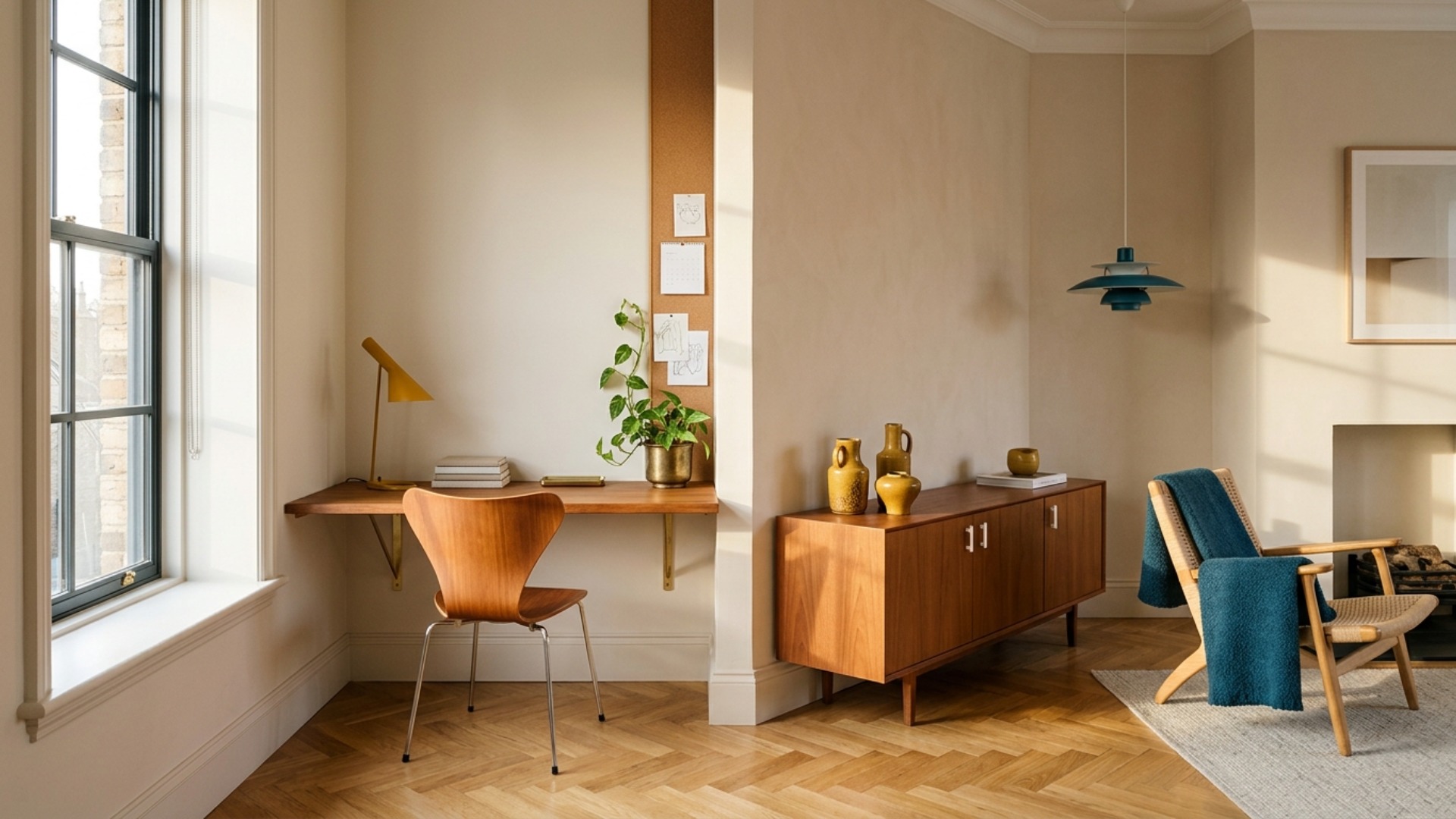
The real problem
Why this is harder than it looks
A studio home office is not a small office. It is a bedroom, a living room, and a workplace occupying the same two hundred square feet, and the hardest part is not fitting the desk in. It is that the desk never leaves. At seven in the evening the laptop, the second monitor, and the stack of paperwork are still there, three feet from where you are trying to stop thinking about work.
Mid century modern is unusually well suited to this, and not for the reason people assume. It is not about the walnut. The style was built for postwar apartments where one room did several jobs, so its furniture is designed to be seen from every angle: backs are finished, legs are exposed, cabinets are shallow and wall hung, and nothing depends on being pushed against a wall to look right. In a studio, where your desk is permanently in your peripheral vision from the bed, furniture that looks good from behind is worth more than furniture that is merely compact.
The practical starting point is a studio between 300 and 500 square feet, one window, a radiator under it, and a single alcove or chimney breast recess that is the only sensible spot for a desk. There is no door to close, no spare wall, and often a lease that rules out anything drilled or permanent. Whatever you choose has to work as furniture in a living room first and as a desk second.
The failure pattern is buying a small desk. A cramped 90cm folding table jammed beside the bed makes work unpleasant without making the room feel bigger, because what actually costs you space in a studio is not the desk footprint but the visual mess of an office in a home. The better trade is a slightly larger, genuinely beautiful worksurface with enough closed storage nearby that the entire job disappears in ninety seconds at the end of the day.
A clear path
How to plan it
-
01
Choose the wall before you choose the desk
In a studio there are usually only two or three viable positions, and they differ enormously. An alcove beside the chimney breast gives you depth and a natural frame. The window wall gives you light but puts you in front of a radiator and often a bad video call backdrop. The wall facing the bed is the one to avoid, since it puts work in your line of sight while you sleep. Decide the wall first, then buy something to fit it.
-
02
Float the worksurface so the floor stays visible underneath
A wall hung or slim legged worksurface, ideally 55 to 70cm deep and spanning the full width of an alcove, does more for a small room than any folding desk. Keeping the floor visible beneath it is the specific trick that stops a studio feeling blocked, which is exactly why mid century pieces sit on legs. If drilling is not allowed, a teak console on tapered legs achieves nearly the same effect.
-
03
Buy the closed storage that lets work disappear in ninety seconds
This is the piece that actually makes a studio office livable, and it is the one people skip. A low mid century sideboard or a shallow wall hung cabinet gives the laptop, cables, notebooks, and paperwork somewhere to go at the end of the day. Set a rule that the surface is clear by evening, and buy enough closed volume to make that realistic rather than aspirational.
-
04
Use one chair that works at the desk and in the room
A studio cannot absorb a black mesh office chair, since it is visible from the bed and from the sofa and belongs to neither. A wood framed chair with a proper back, an Arne Jacobsen Series 7 or similar, looks right in a living room and tucks fully under the worksurface when you finish. If you work eight hours a day, add a proper seat cushion or accept a real task chair and choose one in a muted colour rather than black plastic.
-
05
Test the desk position from the bed in Framehouse before you buy
In a studio the workspace is judged from the bed and the sofa far more often than from the chair, and that is the view no product photograph will show you. Photograph the room from both, then use Framehouse to test the alcove against the window wall, and a floating surface against a console. Getting the position wrong costs you the feel of the whole apartment, not just a corner of it.
Built for studio maximization
Moves that pay off
A studio has no spare room to give, so the workspace has to earn its footprint as furniture as well as function.
- Pick the wall first, and rule out anything in direct sight of the bed.
- Buy one slightly larger beautiful worksurface rather than one small ugly desk.
- Prioritise closed storage, since hiding work at the end of the day is the whole problem.
- Choose pieces that look finished from behind, because in a studio everything is seen from all sides.
- Use vertical wall space for storage instead of taking more floor.
- Keep a single lamp for work and a different one for the evening, so the light changes when the day ends.
mid century modern cues
What to keep, what to skip
Mid century modern suits a studio because it was designed for rooms doing several jobs at once. Aim for these.
- Palette: warm chalk plaster walls, oiled teak or walnut, with one mustard, petrol blue, or burnt orange accent.
- Materials: tight grained teak, oak parquet, unlacquered brass, papercord, and wool in a flat weave.
- Signature: raised legs and finished backs, so furniture floats and reads well from every angle.
- Proportion: shallow and wall hung storage rather than deep and floor standing, which buys back usable floor.
- Lighting: one sculptural pendant such as a PH5 for the room, plus a small task lamp for the desk.
- What to skip: black mesh office chairs, a full reproduction theme room, and bulky filing units of any kind.
Use it for
What people plan with Framehouse
- Test an alcove desk against a window wall position
- See the workspace from the bed before committing to it
- Try a floating worksurface against a console on legs
- Check whether a sideboard hides enough to clear the desk nightly
- Plan a video call backdrop that is not your bed
Quick answers
Common questions
Make a plan you can act on
Skip the spiral of mood boards. Three minutes in the Aura Quiz turns your taste into a direction.
Take the Aura Quiz