Coastal Studio Apartment Ideas for a Luxury Upgrade
Coastal at the top end is not more beach, it is fewer and better things: real linen, real stone, and light allowed to do most of the work. This page walks through how to spend a serious budget on one room without turning it into a themed hotel suite.
The real problem
Why this is harder than it looks
Most coastal studios fail at the shopping stage, not the design stage. Coastal is the easiest style in the world to buy badly, because the market has decided it means motif: rope-wrapped lamps, navy stripes, a driftwood sculpture, a framed sailboat print. In a house those signals get diluted across six rooms. In a studio they all land in one sightline, and the result reads as a rental beach cottage no matter how much the sofa cost.
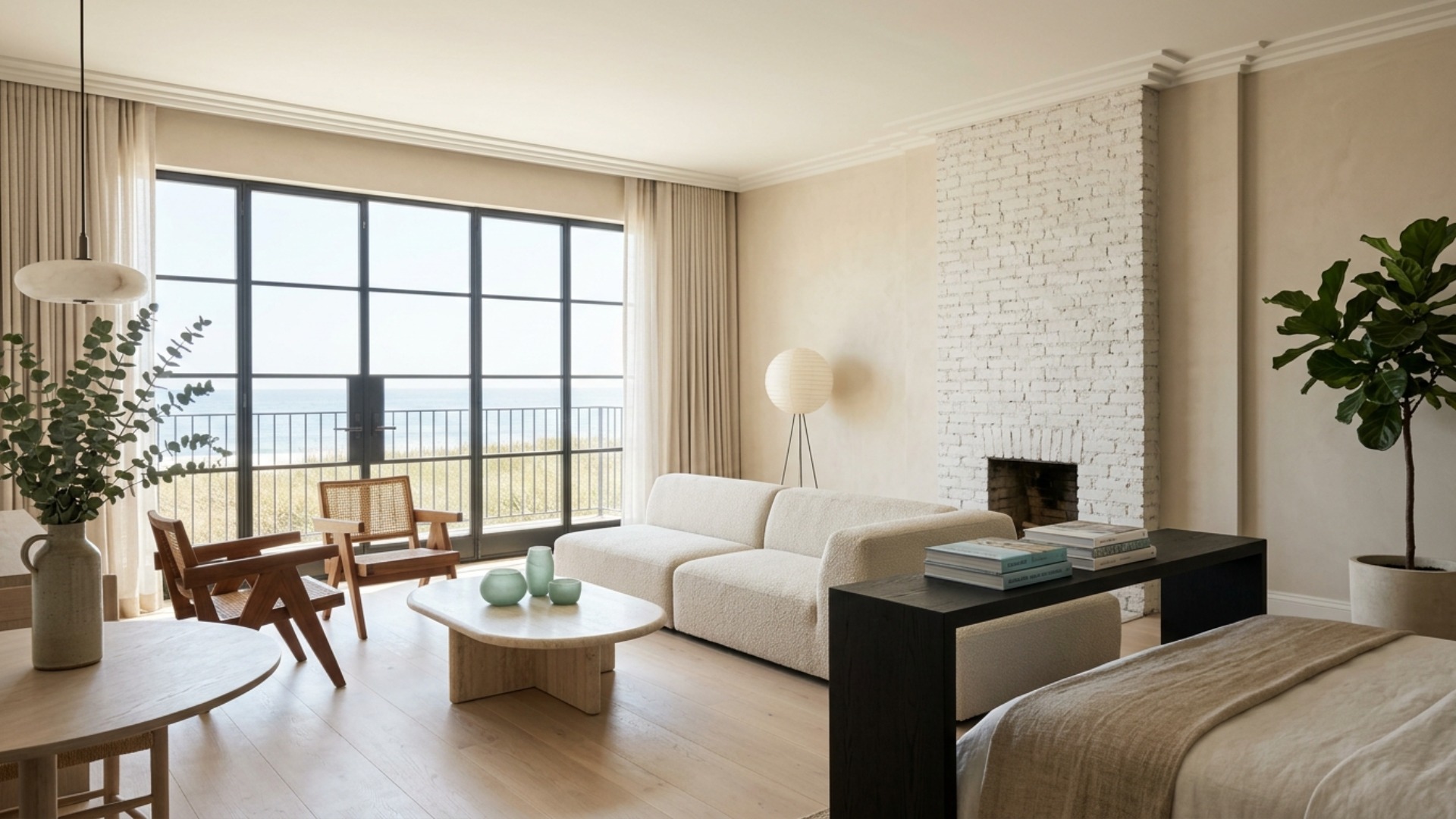
What is actually happening in the coastal rooms you saved is a light story. The palette is low chroma and warm: sand, oatmeal, bone, driftwood grey. The materials are honest and slightly worn, linen that creases, oak that has been bleached rather than stained, plaster and limestone that absorb light instead of throwing it back at you. Nothing on the wall says ocean. The room simply behaves the way a room near water behaves, bright and flat and a little washed out.
A studio at this budget is usually a specific situation: a good building, one genuinely good window, and an envelope nobody has touched since it was built. Builder-grade laminate floors, flat white walls with a blue undertone, a laminate kitchen run along one side, and a single ceiling fixture doing all of the lighting. That envelope is what a visitor reads first, well before they get to any of the furniture.
So the failure pattern is spending in the wrong order. In a studio there is no second room to hide anything in, which means the furniture and the envelope are judged together, at once. A nine thousand dollar sofa sitting on builder laminate under a flush-mount ceiling light does not read as luxury. It reads as one expensive object in a cheap room, which is a worse outcome than a modest sofa in a room whose floors, walls, and light have been sorted out.
A clear path
How to plan it
-
01
Fix the envelope before you buy a single piece of furniture
Floors, walls, and window casings account for most of the surface area a visitor sees, and in a studio they are all visible at the same moment. If the floors are orange-toned laminate, budget for engineered white oak in a wide plank with a matte or invisible finish, which is the highest-return line item in a coastal studio. For walls, warm off-white only: Benjamin Moore Swiss Coffee OC-45 or Farrow and Ball School House White both read as sand in daylight, while anything with a blue or grey undertone will go cold the moment the sun moves.
-
02
Buy the window treatment you actually want, in linen, ceiling mounted
The window is where coastal lives, so this is not the place for ready-made panels. Order unlined or lightly lined Belgian linen in a warm oatmeal, hung from a ceiling-mounted track rather than a rod, running floor to ceiling and past the window frame on both sides. Expect roughly forty to seventy dollars a yard for good linen plus labour, and expect it to change the room more than any piece of furniture at the same price.
-
03
Replace all of the lighting, not some of it
One ceiling fixture is what makes a studio look like an apartment instead of a home. Aim for four or five separate sources at different heights: a plaster or alabaster pendant over the dining spot, two sconces on the wall behind the bed, a paper floor lamp near the seating, and warm 2700K bulbs throughout. Put all of it on dimmers, because coastal wants flat bright daylight and low warm light at night, and very little in between.
-
04
Zone the room with two large pieces, not six small ones
The instinct in a studio is to buy small, and it is wrong. Two generous pieces, a deep sofa and a real dining table, read as a considered home, while six apologetic little pieces read as a dorm. Use one tall open-backed piece, a slatted oak screen or a low console, to separate the bed from the living zone, and leave the floor visible underneath so the eye keeps travelling.
-
05
Visualize the finished room in Framehouse before you commit the spend
Coastal succeeds or fails on undertone, and undertone is the one thing a paint chip and a fabric swatch cannot tell you. Upload a photo of your studio as it is now and generate the coastal version before you order the floors, the linen, or the sofa. It costs nothing to find out that the off-white you liked goes grey against your particular window, and it costs several thousand dollars to find that out afterwards.
Built for luxury upgrade
Moves that pay off
A luxury upgrade in a studio is a sequencing problem more than a taste problem. The budget is real, the square footage is not, and the order you spend in decides whether the room reads as finished or merely as expensive.
- Spend the first third of the budget on floors, paint, and lighting, before you look at a single piece of furniture.
- Buy the sofa and the dining table at full quality and buy them once. Everything else can be replaced later without disturbing the room.
- Defer the art. Coastal rooms carry far less on the walls than you expect, and a wrong piece is more visible here than in any other style.
- Do not upgrade appliances yet if the kitchen run is laminate. Refacing or replacing the fronts changes the room. A better dishwasher does not.
- Skip the rug until the floors are in. The right rug against new white oak is a different rug from the one that worked over old laminate.
- Keep one thing you already own that has nothing to do with coastal. A room with no history in it reads as a showroom.
coastal cues
What to keep, what to skip
Coastal is a narrow style done well and a cliche done badly, and the difference sits almost entirely in the palette and the materials.
- Palette: warm off-white, dry sand, oatmeal, bone, and driftwood grey, with exactly one accent. Sea glass green and pale clay both work. Navy does not.
- Wood: bleached or whitewashed oak, never orange-toned. If the existing wood is warm, a limewash is far cheaper than replacing it.
- Stone: honed limestone, travertine, or a soft quartzite. Polished surfaces and heavy veining both fight the light this style depends on.
- Textiles: washed Belgian linen, raw jute, undyed cotton, and one woven element such as caned teak or a rattan shade. Texture is what keeps a low-chroma room from going flat.
- Structural signature: an uninterrupted run of light. Keep window treatments outside the frame, keep the sightline to the window clear, and let one wall stay empty.
- Skip: rope, anchors, stripes, blue and white ginger jars, sailboat art, and shiplap. Every one of them reads as costume rather than architecture.
Use it for
What people plan with Framehouse
- Test a warm off-white against your studio window light before buying paint
- Compare bleached oak floors with the kitchen cabinets you already have
- Check that a sofa suits the seating zone before you order it
- Show a partner what the finished studio will actually feel like
- Decide whether the bed needs a screen or just a change of rug
Quick answers
Common questions
Make a plan you can act on
Skip the spiral of mood boards. Three minutes in the Aura Quiz turns your taste into a direction.
Take the Aura Quiz