Scandinavian Studio Apartment Ideas for a Luxury Upgrade
A studio does not become expensive by acquiring expensive things. It becomes expensive when the wall planes do the work and the furniture stops apologising for the lack of doors. Here is where a Scandinavian studio upgrade earns its money, and the two places most people waste it.
The real problem
Why this is harder than it looks
Almost every studio upgrade begins as a shopping trip. A Wegner lounge chair arrives, then a proper wool rug, then a good bed, and the room is objectively better furnished and somehow no more impressive than it was. The reason is that a studio is read in a single glance from the door, and a glance takes in planes before it takes in pieces. If the first thing the eye meets is a bed and a stack of storage boxes, the chair will not save it.
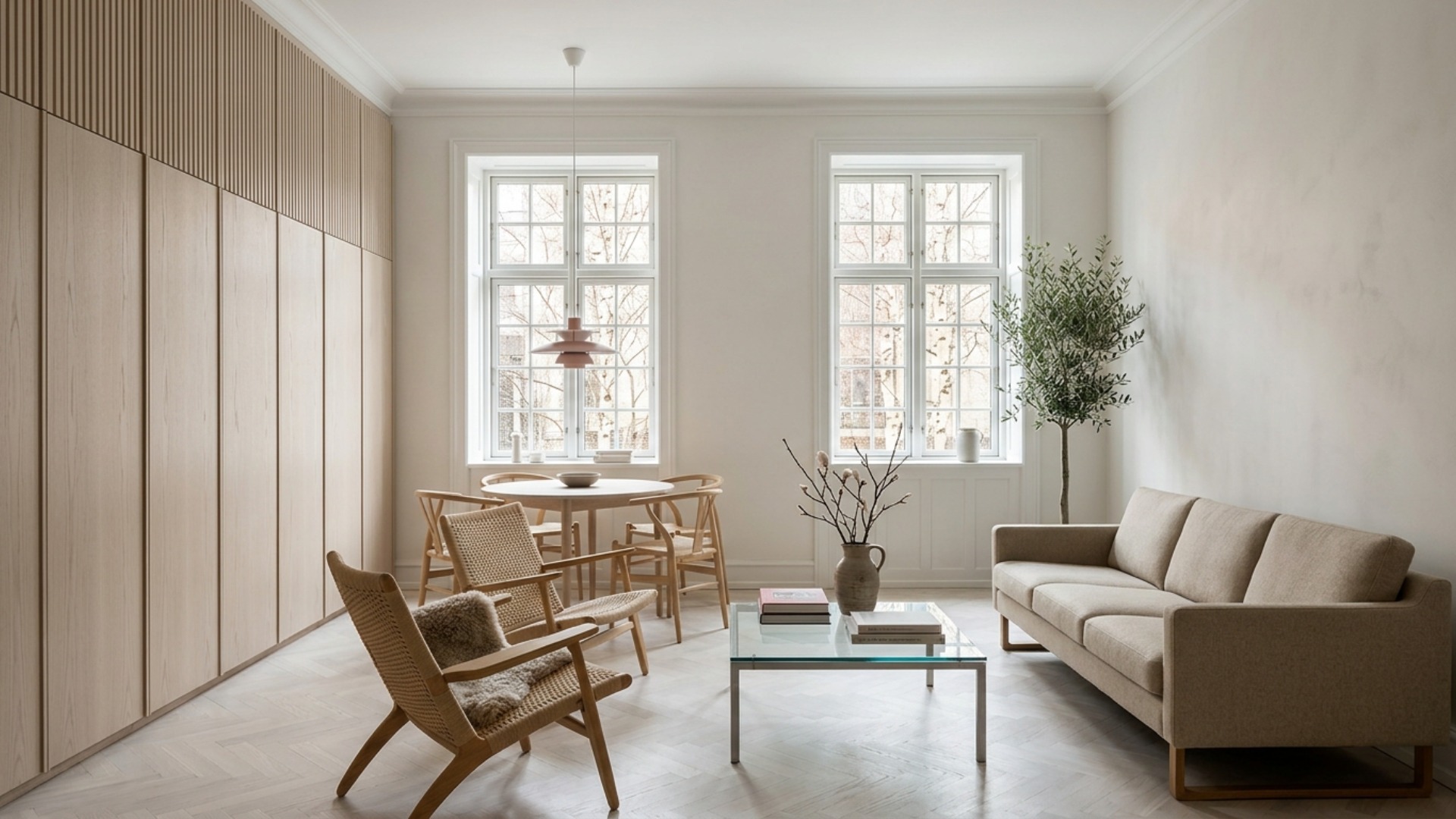
The Scandinavian studios that photograph like apartments twice their size share one trait, and it is not furniture. It is that the storage has stopped being objects and become architecture: a single continuous run of joinery, floor to ceiling, one material, one reveal line, absorbing the wardrobe, the pantry, the vacuum cleaner, the bike helmet and quite often the bed itself. Everything the room needs is behind one plane, and the remaining floor is free to hold three good things instead of eleven adequate ones.
Your situation is the useful kind. The studio works, you are not fighting a landlord, and the budget is discretionary rather than remedial, which means you can spend on the invisible half of the project. That is unusual and it is worth protecting, because discretionary money drifts toward whatever is easiest to order online.
The failure pattern is buying icons and placing them in an unresolved room. A CH25 lounge chair next to a flat-pack chest of drawers does not read as a mix, it reads as an accident, and the better the chair the more obvious the mismatch becomes. Scandinavian design is quiet enough that it cannot carry a room on charm. If the background is unresolved, the good pieces just make the unresolved parts louder.
A clear path
How to plan it
-
01
Decide what the room is in the first two seconds
Stand at the front door and photograph what you see. If the bed is the first thing in frame, the whole apartment reads as a bedroom with a sofa in it, and no amount of spend will change that impression. Reorganise so the entry view lands on the seating group or the window, and treat that single decision as the brief for everything that follows.
-
02
Build one wall of joinery and let it absorb everything
A single floor-to-ceiling run in pale ash or birch veneer along the longest solid wall is the highest-value thing you can commission in a studio, typically 6,000 to 15,000 dollars fitted. Ask for a fluted or plain flat front with no handles, one continuous reveal, and a section deep enough for hanging clothes at 600mm. Everything ugly in the apartment goes behind it, which is what actually buys you the calm.
-
03
Fix the floor and the windows before you buy a single chair
A studio has one floor and it is visible from everywhere, so a sand and matte white oil on existing boards, or new engineered pale ash, changes more than any furniture purchase. Pair it with full-height linen curtains hung from the ceiling rather than the frame, in an off-white that matches the wall to within a shade. Ceiling-hung curtains are the cheapest trick in this style and they add apparent height immediately.
-
04
Buy three real pieces and stop
A studio can carry three pieces of genuine quality and no more: usually a sofa, one lounge chair, and a dining table with chairs. Something like a Borge Mogensen 2213 or a Fredericia Delphi, a Wegner CH25 in soaped oak, and a small round ash table with four Wishbone chairs. Buying a fourth and fifth statement piece does not compound the effect, it competes with it, and in a single room competition reads as clutter.
-
05
Handle the noise and the textiles, because a studio has nowhere to hide
One room doing four jobs is acoustically hard, and hard rooms feel cheap regardless of what is in them. A dense wool rug with a felt underlay, floor-length curtains, an upholstered headboard or a wall-hung textile, and a bookcase with actual books will drop the reverberation noticeably. This is the least photogenic money in the project and the most obvious once you live there.
-
06
Cut the ceiling light and work at three heights instead
Nothing flattens a studio faster than a single central fitting. Put a Louis Poulsen PH5 or an AJ floor lamp over the seating, a low pendant over the dining table hung around 600mm above it, and a warm wall light near the bed, all at 2700K and all on separate switches. Three pools of light at different heights make one room read as three zones without a single wall being built.
Built for luxury upgrade
Moves that pay off
See the whole room resolved before you commission the joinery
scandinavian cues
What to keep, what to skip
Built-in joinery is the one item in this project you cannot return, and the difference between pale ash and white lacquer against your particular floor is not something a veneer sample answers. Photograph the studio from the entry and run it through Framehouse to see the finished wall in each option, with the bed concealed and the seating in place. Do this before the cabinetmaker measures, not after they quote.
Use it for
What people plan with Framehouse
- A luxury upgrade in a studio is unusual because there is no scope to add rooms, so the whole budget goes into quality and concealment rather than into square footage. That changes the order of operations.- Commission the joinery first and let its lead time set the schedule. Cabinetmakers quote in weeks, and everything else in the project can be bought in days.- Spend on the bed and its concealment before the sofa. In a studio the bed is the largest object and the one most likely to undermine the room, so a wall bed, a low platform, or a joinery recess earns more than an upgraded sofa.- Do not add a second seating group. A studio has room for one, and the impulse to create a reading corner usually produces a stranded chair.- Replace the internal doors and the entry hardware. It is a small line item that people notice within three seconds of arriving, and hollow-core doors undo a lot of expensive work.- Skip the room divider. Screens, shelving units and curtains hung mid-room all announce that the space needed dividing, which is the impression you are paying to avoid.- Keep one wall completely empty. In a single-room apartment, unused wall is the clearest signal that the space is bigger than it needs to be.
- Scandinavian at the high end is warmer and softer than the version that reached flat-pack retail. It relies on light woods, real textiles, and a small number of well made pieces rather than on white surfaces and minimal clutter.- Palette of chalk white or a warm off-white on the walls, pale ash or birch on the floor and joinery, and one muted accent. Farrow and Ball Wimborne White or Jotun Egghvit both hold up in northern light.- Soaped or white-oiled oak rather than lacquer. The matte surface is most of the difference between the real thing and the imitation.- Real textiles carrying the warmth: wool, linen, sheepskin, paper cord. Scandinavian rooms are not minimal, they are soft.- One structural signature: continuous light-wood joinery running the full height of a wall, with no visible hardware.- Brushed nickel or matte steel rather than brass. Warm metals push the room toward mid century modern, which is a different look.- Skip the all-white scheme, the reindeer hide, and the wall of framed line drawings. Each one dates the room to a specific catalogue year.
- Compare pale ash and white lacquer joinery against your actual floor
- See the room with the bed concealed before commissioning cabinetry
- Test whether the entry view should land on the sofa or the window
Quick answers
Common questions
Make a plan you can act on
Skip the spiral of mood boards. Three minutes in the Aura Quiz turns your taste into a direction.
Take the Aura Quiz